


SEO for a remodeling company: how to win a job that a homeowner decides over three months and three quotes
A kitchen is a five-figure decision made slowly, against two other quotes, by someone who will read your site three times. The remodeler who publishes what his own projects actually cost beats the national estimator sites for his own city. Audit from €250.
- Project pages with real costs
- Audit from €250
- Named by ChatGPT and AI search
What SEO for a remodeling company actually consists of
- A page per project type and roomKitchens, bathrooms, lofts, extensions, whole-house
- Cost pages built from your own jobsReal ranges, your city, not national averages
- Duration and disruption answeredHow long, and whether they can stay
- Finished projects as pages, not a galleryBefore, after, scope, cost, what changed
- Enquiries that do not cost per leadInstead of one enquiry sold to four firms
- Being named by AI assistants«Kitchen renovation in my city, rough cost, how long»

Renovation and investment website with a premium feel and 96/98/100/100 performance
96/98/100/100Design system2 languages
Auto Repair SEO & UX Boost
Performance 90++10% organic trafficLeads from forms
Full WordPress Rebuild for a Car Rim Restoration Company
92/91/96/100Photo quote formLocalBusiness markup
A multilingual landing page for a wheel and tyre storage business
100/95/100/1003 languagesClient edits it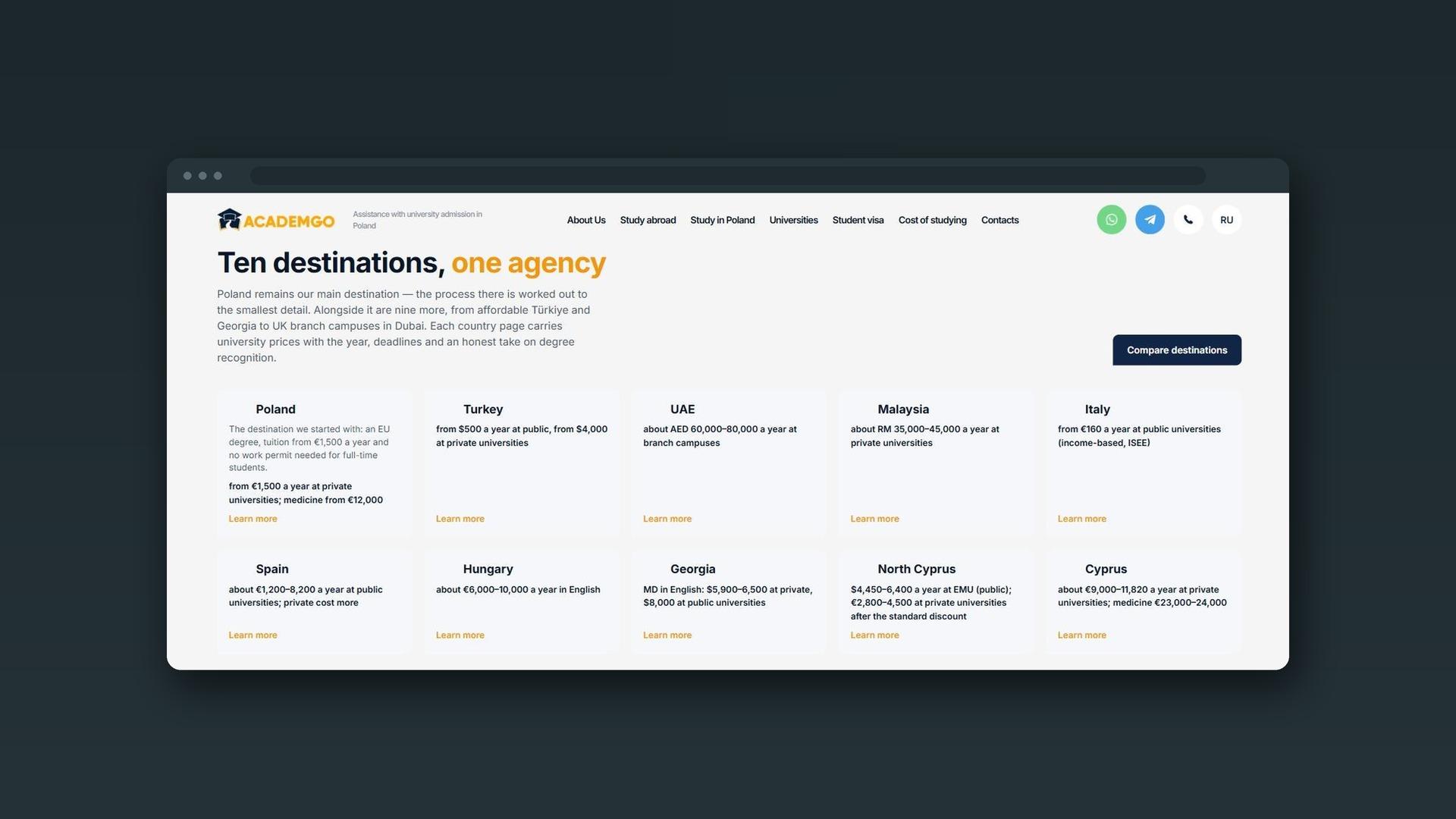
SEO case study: an education agency site, one country to ten
1 → 10 countries180 new pagesPerformance 61 → 91
I do SEO for remodeling companies myself: audit, the fixes in the code and the text, and a monthly report on enquiries.
This page is about renovating homes people already live in, sold to the homeowner: kitchens, bathrooms, loft and basement conversions, extensions, whole-house refurbishment. That client, that price and that decision process are specific enough to need their own approach, and different enough from the neighbouring trades to be worth separating before anything else.
If you build new houses, the buyer and the cycle are different and that is SEO for home builders. For commercial and structural work it is SEO for construction companies. For trade work across many job types it is SEO for contractors, and for design-led work without the building it is SEO for interior designers.
The most searched question in remodeling is what it costs. A kitchen, a bathroom, a loft conversion, a square metre of refurbishment — these are typed hundreds of times a day in every city, and almost no remodeling company answers them. The field is left to national cost-estimator sites and lead platforms, which publish a country-wide average assembled from somebody else's jobs, and the homeowner reads a number that is wrong for their city, their building and their standard of finish.
A company that publishes real ranges from its own completed projects — in its own city, with the scope that produced each figure — outranks those sites for the local version of the question, because it is the only page on the subject that is actually about the place the searcher lives. It also does something more valuable than ranking: it ends the conversations with people whose budget is a third of the job, before the site visit, the measuring and the three days of quoting.
- a range rather than a single figure, with what sits at each end of it;
- the scope that produced the number — what was included, what was not;
- your own finished jobs as the source, with the year, since prices move;
- what pushes a job to the top of the range: structural work, moving services, a difficult building;
- and the minimum project you take, which saves everybody the enquiry.
«from €X» and «every project is unique» both lose the search
Two habits keep remodelers off these pages. The first is a single «from» figure, which the homeowner correctly reads as the cheapest job you ever did and discounts entirely. The second is the sentence that every project is unique, which is true and answers nothing: the person asking knows their kitchen is not identical to the last one, and is asking for an order of magnitude so they can decide whether to keep reading.
The version that works gives three bands with what distinguishes them, and says plainly which band most of your work falls into. It takes an afternoon with your own invoices, and it is the highest-value page most remodeling companies do not have.
Remodeling has one of the longest decision cycles in local trade. The homeowner starts looking in January, gets three quotes in March, and signs in May, and in between they come back to each company's website several times — once to look at the work, once to show a partner, once to check something they half-remember. Most of this trade's SEO is sold as though the goal were a phone call on the first visit. The actual goal is to be the company that still looks like the right choice on the third visit, when they are comparing you with two others.
That shapes what the pages have to contain. Finished projects with the scope, the duration and the cost band rather than a carousel of photographs. The names of the people who would be in the house. What happens when something is found behind a wall. Who handles permits and building control. How payments are staged. None of this ranks on its own, and all of it decides the comparison that search produced.
Answering how long it takes and whether they can live there
After cost, the two questions are duration and disruption, and they are asked constantly: how long a kitchen takes, whether the family can stay in the house, whether there will be water, which weeks are the worst. Almost no remodeling site answers them, which is strange, because they are the cheapest pages to write — the answers are the same on every job — and they catch the homeowner at the exact moment they are deciding whether to do the work at all.
These pages also pre-empt the awkward part of the sale. A company that has already written down that the bathroom is unusable for nine days is not going to be accused of hiding it in week two.
Most remodeling companies buy leads from a platform, where one homeowner's form is sold to three or four firms at once. You pay for the enquiry, you compete on price against two companies who paid for the same enquiry, and the homeowner — who never learned any of your names — picks on the cheapest quote. The margin for the whole arrangement comes out of the job.
Search works the other way round: the enquiry arrives with your name attached, having read your project pages and your cost bands, and usually without the other two quotes being in the same conversation. That is the economic case for this work, and it is also the honest limit of it: it takes months to build, it does not replace the platform in the first quarter, and anyone who tells you otherwise is selling you a campaign rather than a plan.
Where you want to be found across several districts or towns, the groundwork is on local SEO for contractors, and if you want to know what is wrong before committing to anything, that is the SEO audit.
An SEO audit for your remodeling company
Send the site and I reply within one working day: what is holding it back and what I would do first.
Being named when a homeowner asks ChatGPT about a renovation (GEO, AEO)
«What does a kitchen renovation cost in my city, how long does it take, and who does it» is now one question put to an assistant rather than three searches, and remodeling suits it unusually well, because every part of the answer is a fact somebody has to have written down. The assistant answers from text it can read, so the same things decide whether a company is named: project types and cost bands written as text, durations stated, the area covered, and the same name, address and phone number across the site, the Google profile and the trade directories.
Getting an existing site into a readable state is preparing a site for AI search, and if assistants describe the company wrongly — work you no longer take, towns you have dropped, an old price — that is fixing AI misinformation.
SEO for remodeling companies: frequently asked questions
Remodeling SEO and AI search: ChatGPT, Perplexity, Gemini and AI Overviews
People ask ChatGPT, Perplexity, Gemini or Google’s AI Overviews which remodeler nearby does whole-house projects and what a kitchen remodel costs in their city. The assistant answers from text it can read, and names companies whose pages carry the facts: project types, price ranges, service area and finished projects.
Work on being named there goes by two labels, generative engine optimization (GEO) and answer engine optimization (AEO). In practice it comes down to plain text instead of images, structured data for the company and its services, and details that match the Google profile.
Order an SEO audit for a remodeling company: what to send me
Send the site, say which project types you want more of, and tell me whether you are currently paying a platform per lead. I reply within one working day with what is holding the site back, which cost and duration pages are missing, and what I would do first — including an estimate of how long it would take before search replaces any part of what you are paying per enquiry now.
