


Website design for phone repair shops: a shop window that gets him to walk the four hundred metres to your counter
I build websites for phone and electronics repair shops. Nobody is dispatched in this trade — the customer walks in, and he walks in to whoever answers four questions first: the price for his model, whether the part is in stock, how long he waits and which floor you are on. Website from €2000, audit of an existing one €250.
- Price list by model
- Found by ChatGPT and AI search
- Website from €2000
Website design for a phone repair shop: what the work consists of
- A price list he can read by modelNot «from», not «on request» — the number
- Waiting time and stock on the pageForty minutes while you wait, part in today
- Directions to the actual counterFloor, entrance, what the sign looks like
- Ready for AI search from day oneStructured data, readable text, real figures
- Laptops and tablets built inA bigger ticket, and almost nobody publishes it
- Fast on a phone with a cracked screenUnder two seconds, one thumb, bad signal
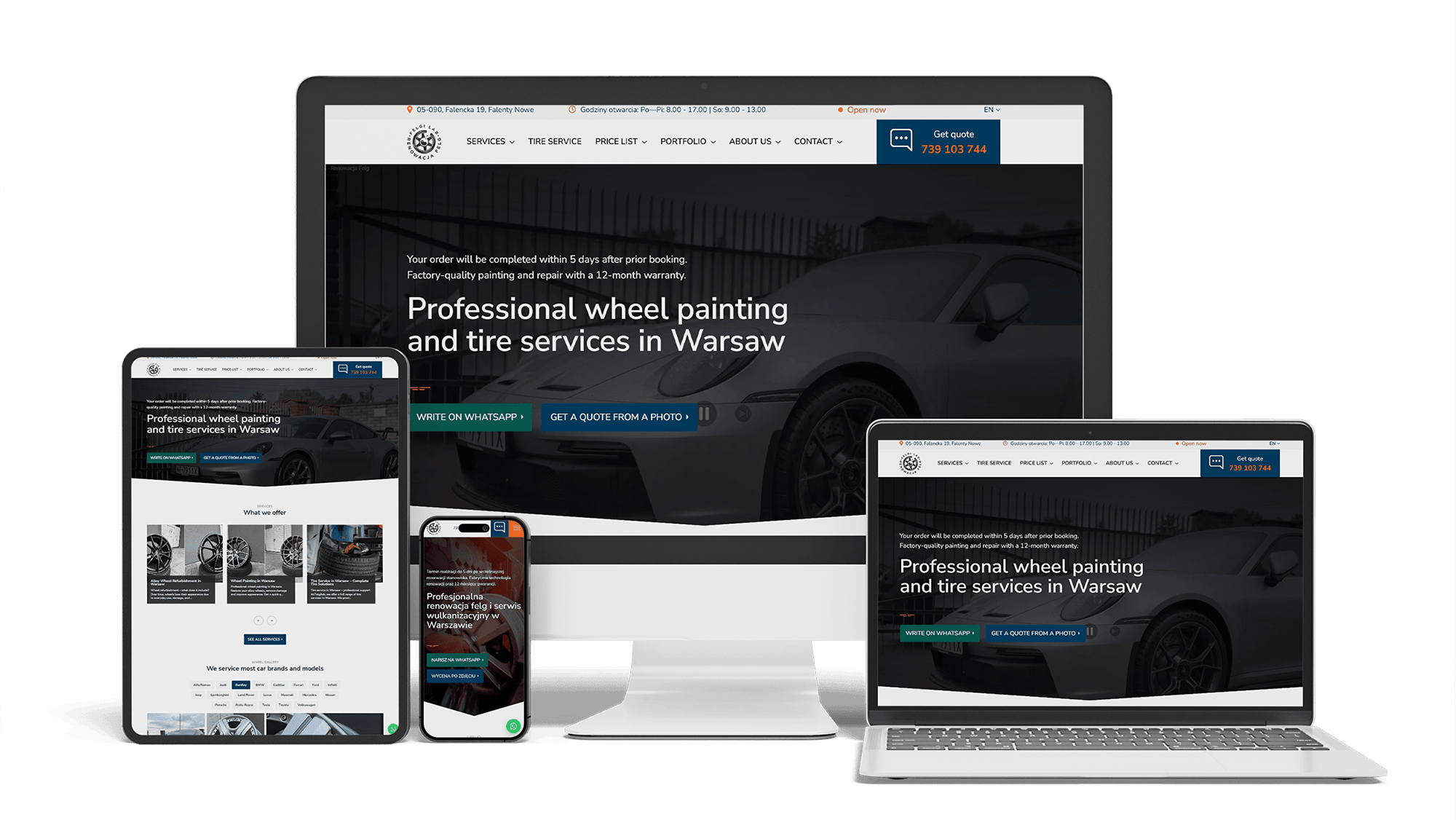
Full WordPress Rebuild for a Car Rim Restoration Company
92/91/96/100Photo quote formLocalBusiness markup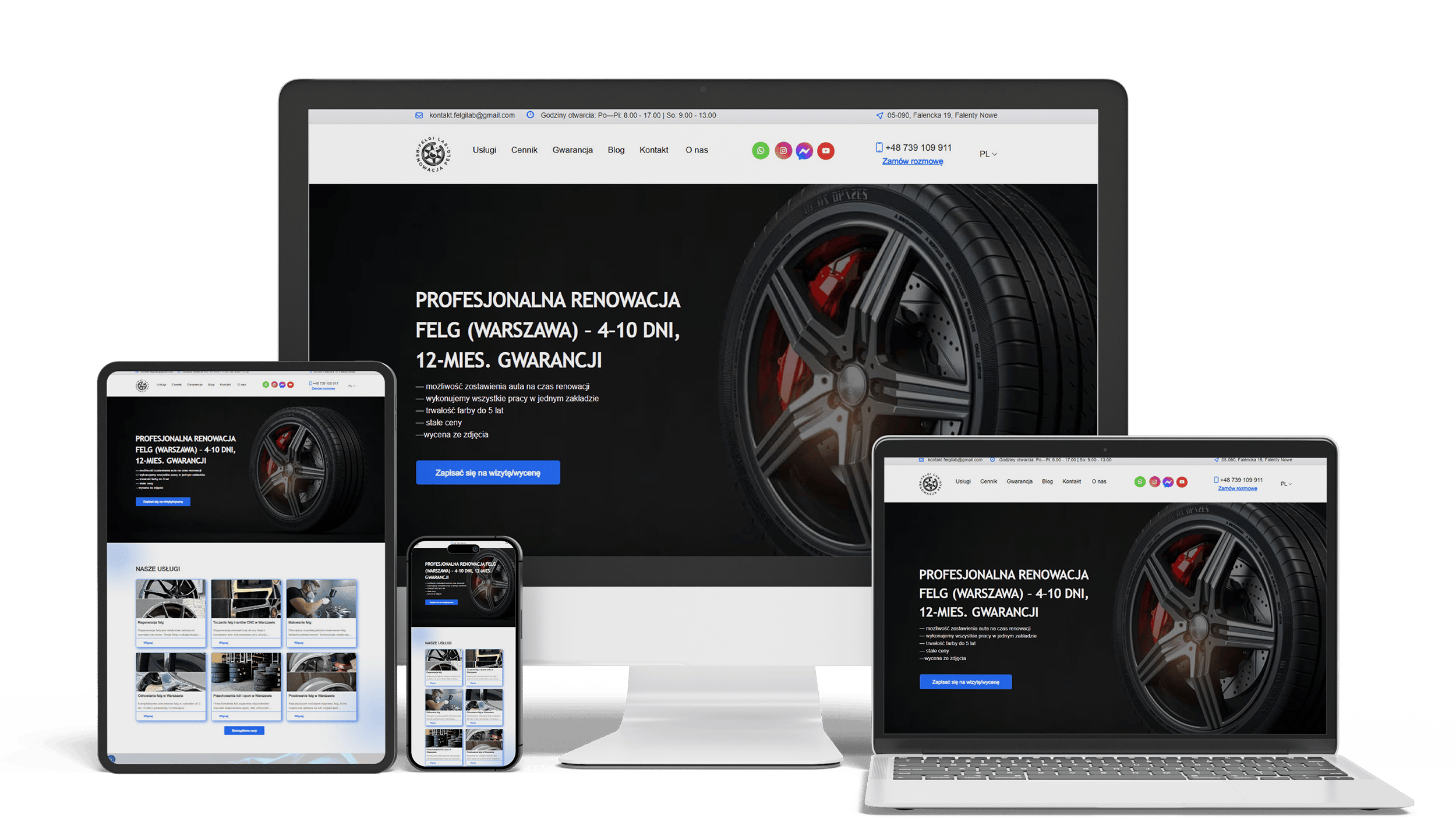
Auto Repair SEO & UX Boost
Performance 90++10% organic trafficLeads from forms
Web Development a Website for Internet Prowider
Coverage mapTariffs by zoneSchema.org markup
E-commerce landing page with secured video access
100+ course sales0 leaksLinks expire in 14 days
Architecture Website Rebuild and SEO
29× organic trafficLoads in under 1 sTop 3 in Poland
I build websites for phone and electronics repair shops. The work starts with one list I need from you: the models you keep parts for, and the price for each.
This trade does not dispatch anybody. No van leaves, no appointment is agreed. A man with a cracked screen is standing on a street that has three repair counters on it, and he is deciding which door to open.
He gives you about forty seconds. In that time your site has to answer four things: what it costs for his exact model, whether you have the part now, how long he will wait, and where your counter actually is.
Everything else — the history of the business, the certificates, the photographs of soldering irons — is decoration that pushes those four answers below the fold.
So the site is built in that order:
- the price list by model, reachable in one tap from the home page;
- stock and waiting time stated next to the price;
- directions precise enough to find a counter inside a shopping centre;
- opening hours that are true right now, including today;
- and only then everything a normal website usually starts with.
Most repair shops publish «from 49 €» or nothing at all, because they are afraid of being undercut. The result is that the decision moves to a phone call the customer does not want to make.
A table of models and repairs with real numbers does the selling. Screen for his model, battery, charging port, each with a price, the part type and the time.
The part that costs nothing and converts: a line saying what changes the price — original versus compatible part, a bent frame, water damage found after opening. Nobody argues at the counter about a number he already read.
Stock and waiting time, written like a shop and not like a service centre
«In stock today» and «forty minutes while you wait» are the two phrases that move someone standing in the street.
If your stock is in a system, the site can show it per model. If it is in your head, the simple version works almost as well: the twenty models you always have, listed by name, and a line saying anything else is ordered by tomorrow.
Half of these shops sit inside a shopping centre, a passage or on the first floor of a block, and their websites give an address that is technically correct and practically useless.
Write the entrance, the floor, what the sign says, the shop next door, and where to park for ten minutes. Add a photo of the storefront taken from the direction most people arrive from.
People do not get lost on the map. They get lost in the last fifty metres, and that is the part every site leaves out.
Most are built by a general studio that starts from a template and a photo gallery. It looks fine and leaves the four answers somewhere on page three.
Three questions sort them out. How will a customer see the price for his own model, in how many taps. Where will the opening hours and the waiting time appear. What does the page look like on a phone with a broken screen, one hand, outdoors, in the sun.
If the answer is about the design system, you are buying a brochure. In a trade decided in forty seconds a brochure simply loses.
The model and repair pages the SEO work will need later
A site built as five pages has nowhere to put the forty model pages that bring the traffic later, and gets rebuilt the moment you start on search.
So the structure goes in from the start, even if the first version carries ten models. How the search side works is on the page about SEO for phone repair shops.
This site is opened on the worst device in the world: the one that is already broken, outdoors, on mobile data, by somebody who is annoyed and in a hurry.
That sets everything. Under two seconds to first paint. Price list reachable in one tap. Phone number as a button that dials. WhatsApp as a button that opens a chat with the model already written in.
And one thing almost nobody tests: the site has to stay readable with the screen half broken, which in practice means large type, strong contrast and no critical information inside images.
«How much does it cost to replace a screen on this model» and «is it worth repairing a phone this old» are asked of assistants before any shop is chosen.
The assistant answers from readable text and names shops whose pages carry figures: price by model, waiting time, part type, warranty.
A site made of photographs has nothing to quote. A site built as a price list is nothing but quotable facts, which is why this pays twice.
Generative engine optimization (GEO), answer engine optimization (AEO) and structured data
GEO and AEO are the same job from two sides: being named inside the generated answer, not only in the list of links. Behind them sit ordinary things — structured data, readable text and company details that match everywhere.
On a new site this costs nothing extra, it is done while building. On an existing one it is preparing a site for AI search.
A full site is from €2000: price list by model, stock and waiting time, directions, repair pages, speed and structured data. A landing page for one brand, one repair or one shopping centre is €700–1400.
An audit of the site you already have is €250 and answers one question: three fixes or a rebuild.
A website for your repair shop
Send what you have now and I reply within one working day: what I would build and what it would cost.
Websites for phone repair shops: frequently asked questions
Order a website for a phone repair shop: what to send me
Send the site you have now, or say you have none. Add the models you keep parts for, your prices for the common repairs, and where exactly your counter is.
I reply within one working day: what I would build, in what order, and what it would cost.
