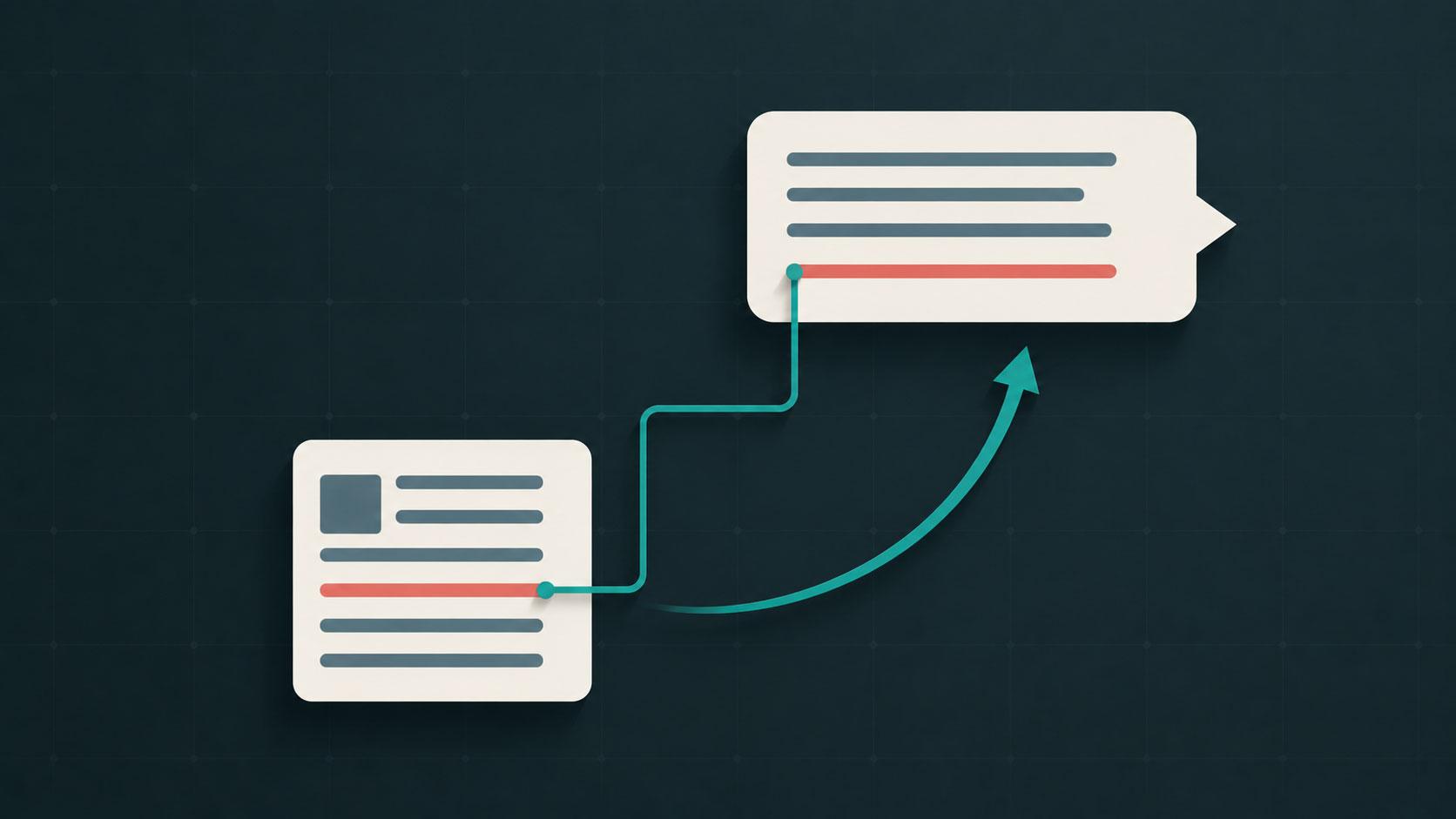



Quick answer: your website describes what you do today. Review platforms describe what customers experienced a year or two ago. Press coverage describes the positioning you had when the article was written. Competitor comparison pages describe you in their framing. An AI assistant reads all of these as equally valid and produces a description that may match none of them. Updating your own site doesn't override the rest — the stale version persists until the sources carrying it are retired or outweighed.
There's a particular frustration in seeing an assistant describe services you stopped offering, a price you changed eighteen months ago, or a positioning you moved away from entirely — while your website, updated last month, says something completely different.
The website isn't the problem. The problem is that it's one source among many, and several of the others are years old and were never designed to be maintained.
Why your current website doesn't override stale information
An assistant assembling a description of your company doesn't treat your site as authoritative. It treats it as one input, and often not the heaviest one.
Third-party sources carry weight precisely because they aren't written by you. A review platform describing your service, an industry directory listing your specialisation, a press article covering your launch — each of those is, from the machine's perspective, independent corroboration. Your own page saying something different reads as a claim, not as a correction.
That produces the situation most companies discover during their first audit: the assistant is describing them accurately, just accurately for a version of the company that stopped existing two years ago.
Where outdated company information actually lives
Stale claims come from a small number of predictable places. Working through them in order of how much trouble they cause:
Your own old pages. Service pages for offerings you dropped, a blog post announcing a pivot you've since reversed, a team page with people who left. Still live, still indexed, still being read.
Review and rating platforms. By nature retrospective — the reviews describe an experience from a year or more ago, and any profile text you wrote when you registered has probably never been touched since.
Industry directories. Registered once, filled in once, forgotten. Frequently carrying an old specialisation, an old address, an old phone number.
Press coverage and announcements. A dated article is a permanent snapshot. It described you accurately in its moment and describes you inaccurately now, and it won't be updated.
Competitor comparison pages. Written by someone with an interest in framing you a particular way, often years ago, and they rank well for exactly the comparisons buyers run.
Your own social profiles. A bio written at registration, describing a company that has since changed.
Aggregators that copied any of the above. The most persistent category, because the original might be corrected while dozens of copies aren't.
- Your own outdated pages — Whatever you last edited — Easy — entirely yours
- Social and profile bios — Written once at registration — Easy, and usually forgotten
- Directory listings — Years, typically — Moderate — a request per platform
- Review platform profiles — Twelve to eighteen months behind — Moderate for the profile, impossible for the reviews
- Press and announcements — Fixed at publication date — Usually impossible
- Competitor comparison pages — Whenever written, in their framing — Impossible directly — only outweighed
- Copies on aggregators — Inherits the original's age — Difficult, often not worth pursuing
How to trace an outdated claim back to its source
Don't guess which of these is responsible. Find out.
Search the claim itself. Take the outdated statement — the old price, the discontinued service — and search that phrasing rather than your company name. Whatever ranks is the likely source.
Check the assistant's citations. Where the platform shows sources, the answer is in front of you. Where it doesn't, the search above substitutes.
Ask the assistant directly. "Where did that information come from" often produces a usable answer, particularly when the reply came from a web search. Treat it as a lead to verify rather than a fact.
Check whether it's a source at all. If the claim appears when the assistant answers from memory but disappears when it searches, no live source is producing it — it's in the model's training data, and no amount of source work will remove it this quarter. The distinction is covered in the audit method.
What to do with each type of outdated source about your company
Your own outdated pages. Three choices per page: update it, redirect it to the current equivalent, or remove it and let the URL return a proper not-found. Leaving an obsolete page live because "it still gets a bit of traffic" is how a discontinued service stays in circulation for years.
Directory and profile listings. Go through them and rewrite the description. Tedious, entirely within your control, and usually the single highest-value afternoon in this whole exercise — many companies have a dozen profiles describing a business they no longer run.
Review platforms. Update the profile text you control. The reviews themselves stay, and that's fine — they're honest history. What matters is that the profile description isn't contradicting your current positioning.
Press coverage. Almost never correctable. The response is to publish something more recent and more authoritative, so the current version is what gets retrieved.
Competitor comparison pages. Also not correctable. The response is to publish your own factual comparison — clearly, without disparagement — so a source describing the distinction accurately exists at all.
How dates and freshness signals stop information going stale again
A structural point that prevents the problem recurring.
Undated content ages invisibly. A page written three years ago with no date reads as current to both a person and a machine, right up until someone notices the price is wrong. Visible publication and update dates let a retrieval system prefer newer material, and let a reader calibrate.
Practically: put a visible date on anything time-sensitive — pricing, services, team, capabilities. Review those pages on a schedule rather than when something goes wrong. And when a fact changes, change it everywhere in the same week, not gradually as you remember each location. Partial updates produce contradiction, and a contradicted fact is worse than a consistently stale one, because the system has no way to choose.
How long outdated information takes to disappear from AI answers
Realistic expectations, because this work is slow and knowing that prevents abandoning it too early.
Where a source is corrected and the platform searches the live web, the change can appear once that page is recrawled — weeks, typically, and faster on frequently crawled sites. Where a source can't be corrected and has to be outweighed instead, the timeline depends on how quickly your newer material gains authority, which is months. Where the claim sits in a model's training data, it doesn't move until a retrain, on a schedule nobody outside the platform controls.
That's why the audit comes first. Establishing which category an error belongs to is what stops you spending three months on something that was never going to respond.
How I work on outdated brand information
The part I insist on doing first is the trace. Rewriting your homepage because an assistant said something outdated is the common reflex and usually the wrong move — more often the claim is coming from a directory profile written in 2022 that nobody has opened since.
Where to start with outdated information about your company
Reduced to one principle: your website is one source among many, and the stale ones don't correct themselves.
A practical step for today: list every place your company is described that isn't your website — directories, review platforms, social profiles, professional listings. Open each one and read the description. Most companies find at least three that describe a business they no longer run, and fixing those is an afternoon's work with disproportionate effect.
If you'd like help finding what's feeding the outdated version, write to me and we'll trace it.