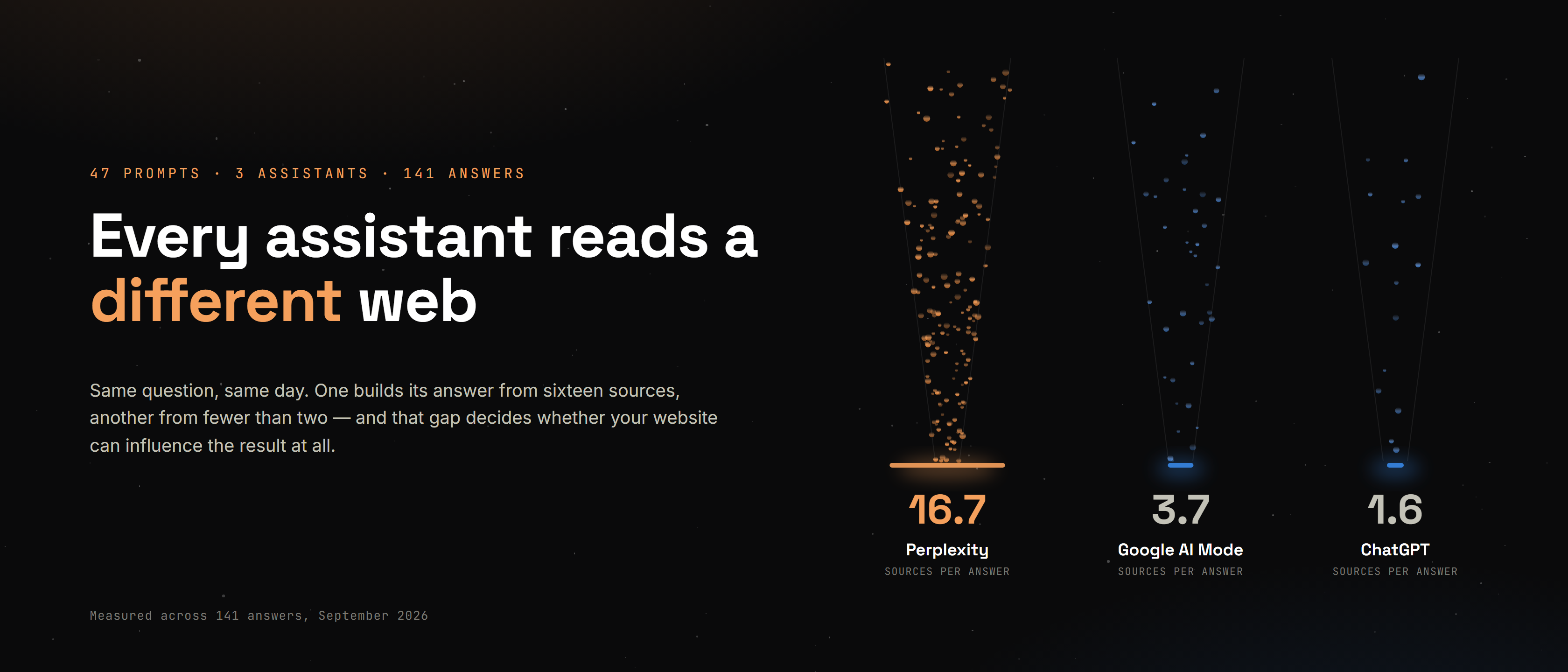


Quick answer: monitoring is the audit repeated on a schedule. Run the same fixed prompt set monthly, in a clean session, across the same platforms, and track four numbers: how many answers named you, how many contained an error, which sources were cited, and how many visits arrived from assistant referrals. Everything else is detail. The hard part isn't collecting the data — it's telling a real change from the natural variation between runs, which is why the set and the conditions have to stay identical.
A single audit tells you where you stand today. It doesn't tell you whether last month's corrections worked, whether a competitor is gaining ground in the answers, or whether a change on your site made any difference at all.
That requires the same measurement repeated under the same conditions. Below is how to set it up so the numbers mean something.
Why AI brand monitoring needs a fixed prompt set
The single most common mistake is improving the prompts between runs.
It's tempting: after the first month you notice better phrasings, more realistic buyer questions, an angle you missed. Adding them destroys the comparison. A change in your presence rate then reflects the new prompts rather than any change in the world, and you've lost your baseline.
Freeze the set. If you genuinely need to add prompts, add them as a second set tracked separately, and leave the original untouched. The original is your measurement; anything else is exploration.
The same applies to conditions. Same platforms, same clean-session approach, same language or languages, roughly the same point in the month. Monitoring is a controlled comparison, and every uncontrolled variable is noise added to a signal that's already faint.
What to track monthly in AI brand monitoring and what each number means
Four numbers carry almost all the value.
- Presence rate — Answers naming you ÷ prompts run — Your visibility in AI answers, the headline number
- Error count — Answers containing a factual error about you — Whether corrections are landing
- Cited sources — Which URLs the assistants referenced — Which pages actually influence answers — often not yours
- Assistant referrals — Analytics segment for traffic from assistant domains — Whether any of this produces visits
Two more worth logging, though they move slowly: which competitors appear alongside you, and how you're described — the adjectives and the framing, not just the facts.
Resist adding metrics beyond this. Sentiment scoring and share-of-voice percentages sound rigorous and are mostly noise at the volumes a single company can measure by hand.
How to tell a real change in AI answers from normal variation
The hardest part of monitoring, and where most people misread their own data.
Assistant answers vary between runs for no external reason. Ask the same question twice in one afternoon and the companies named may differ. That means a presence rate moving from six out of twenty to eight out of twenty tells you very little on its own.
Three rules make the numbers readable.
Look at direction across three months, not month to month. One month up is noise. Three months of the same direction is a trend.
Treat error corrections as binary and specific. "The wrong price is gone from all four platforms" is a real, checkable result. "Sentiment improved" is not.
Note when the world changed rather than your site. A platform updating its model, a new competitor publishing heavily, a piece of coverage appearing — these move your numbers without you doing anything. Log external events alongside the data or you'll credit your own work for someone else's.
Which changes in AI answers deserve an alert
Most monthly movement needs no response. Three things do.
A new factual error appearing. Something that wasn't in the answers last month and is now — particularly about price, capability or availability. New errors usually mean a new source appeared, and finding it early is far easier than after it's been copied.
Your presence rate dropping sharply across several platforms at once. Single-platform movement is normal. Simultaneous movement suggests something structural: a site change affecting crawlability, a page removed, or an indexing problem.
A competitor appearing in answers where they previously didn't. Worth knowing, and worth checking what they published — it's usually traceable.
Everything else goes in the log and waits for the quarterly read.
How often to run AI brand monitoring
Monthly for most businesses. It's frequent enough to catch a new error while it's still isolated, and infrequent enough that the natural variation doesn't swamp the signal.
Weekly is worth it only in specific situations: during an active correction campaign, after a rebrand, or while managing a reputational incident. Outside those, weekly data produces the illusion of movement.
Quarterly is too slow for anything except a very stable business with little competition — by the time you notice an error, it's been shaping decisions for months.
Whatever cadence you choose, keep it. Irregular monitoring produces data you can't compare, which is barely better than none.
AI monitoring tools versus doing it by hand
An honest answer, because the tooling market is loud.
A spreadsheet and an hour a month covers everything above for a single business with one language and a handful of platforms. The data is identical to what a paid tool would produce, because you're running the same prompts against the same assistants.
Dedicated tools become worth their cost at a specific point: multiple brands or markets, several languages, a set large enough that manual running is genuinely hours, or a need for automated alerting rather than a monthly look. If you're one business monitoring twenty prompts, a tool is convenience rather than capability.
What no tool solves is the interpretation — deciding whether a change is real, which errors matter, and what to do about them. That's the part worth your time.
What to report from AI brand monitoring and to whom
If you're reporting to anyone — a client, a board, yourself in six months — three lines are enough.
Presence rate this month against the three-month trend. Errors found, errors fixed, errors that can't be fixed and why. And referral traffic from assistants, stated plainly as the small number it usually is.
Don't report screenshots of good answers. They're selection bias by construction — anyone can find a flattering answer by running enough prompts, and presenting one as evidence undermines the credibility of the numbers that are real.
How I set up AI brand monitoring
What the setup covers: building and freezing the prompt set, establishing the baseline across platforms and languages, defining what counts as an alert, and setting up the referral segment so assistant traffic is visible rather than buried in direct visits.
What I'll say plainly: this measures a slow-moving thing. The first three months produce a baseline and little else, and anyone promising visible movement sooner is selling optimism.
Where to start monitoring what AI says about your brand
Reduced to one principle: same prompts, same conditions, same schedule — the value is in comparability, not in the sophistication of the measurement.
A practical step for today: take the prompt set from your first audit, put it in a spreadsheet with a column per month, and book an hour in your calendar for the same date next month. That's the entire system. The discipline of running it is what makes it work, not the tooling.
If you'd like help setting up monitoring that connects to the rest of your search work, write to me and we'll build it.