


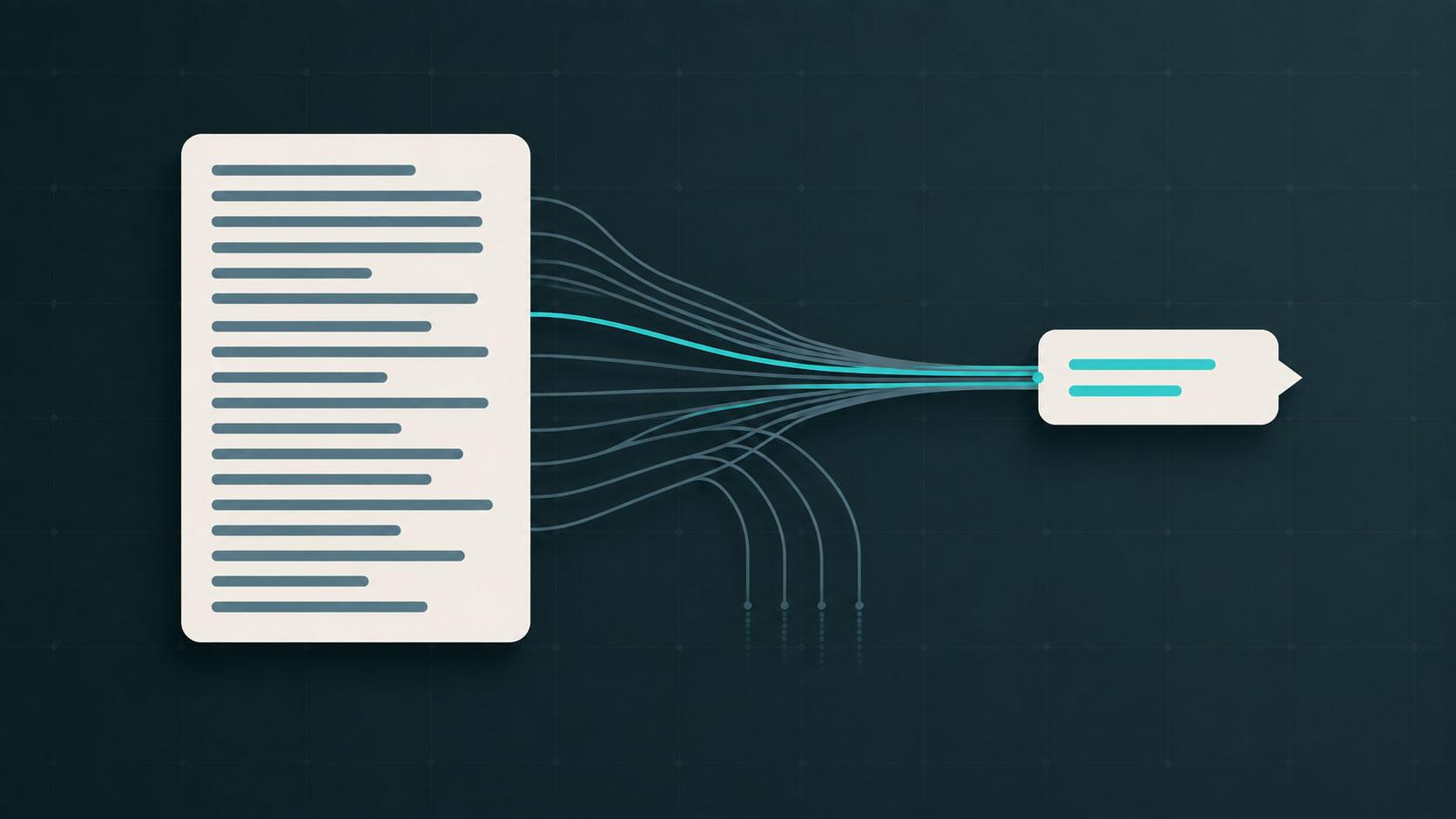
Quick answer: an assistant doesn't quote your positioning, it restates it — compressed into a category and one or two attributes it judged distinguishing. What survives that compression is anything stated as a checkable fact: who you serve, where, what you technically do, what you don't. What disappears is everything aspirational, emotional or comparative-without-substance. Which means the practical fix isn't better marketing language. It's writing the things you want repeated as plain facts, because a fact is the only form that survives being summarised by a machine.
There's a version of your positioning that most prospective clients now encounter before they ever reach your site: the one an assistant gives them in three sentences.
That version isn't a quote. It's a reconstruction, and what gets reconstructed is rarely what you spent the most effort on.
Why AI assistants rewrite positioning rather than quote it
An assistant answering "what does this company do" is performing compression. It has read your site and other sources, and it has to return something short enough to be useful.
Compression selects. It keeps what can be stated compactly and verified against other sources, and it discards what can't. Three sentences of carefully built brand voice compress to a category label plus whatever attributes stood out as concrete.
That's why the result often feels flattened. Not because the assistant misunderstood, but because it kept the parts that survive summarisation and dropped the parts that don't — and the parts that don't tend to be precisely where the differentiation was supposed to live.
What survives an AI summary and what gets dropped
The pattern is consistent enough to plan around.
- Who you serve, stated specifically — "Businesses of all sizes"
- Where you operate and in which languages — Aspirational mission statements
- What you technically do — stack, method, process — "Innovative", "cutting-edge", "passionate"
- What you explicitly don't do — Implied differentiation the reader must infer
- Verifiable credentials and years — Superlatives without a comparison
- Concrete outcomes with figures — "Results-driven", "proven"
- A named approach or method — Brand voice and tone
The pattern underneath: anything checkable survives, anything interpretive doesn't. An assistant can restate "builds multilingual sites on Next.js for real estate agencies" because every part of it is a fact. It can't usefully restate "helping ambitious brands unlock their digital potential", so it either drops it or replaces it with the generic description of your category.
That replacement is the real cost. When nothing specific resists it, a company gets described as a typical example of its category — which is the opposite of positioning.
Why comparison contexts flatten a company toward its category
The distortion is strongest exactly where it matters most: when a buyer asks an assistant to compare options.
In that context the assistant needs comparable attributes across several companies. It looks for the same dimensions in each — price, specialisation, location, scale — and describes everyone along them. Anything that doesn't fit a shared dimension is hard to include, so it gets left out.
The consequence: in a comparison, a company is represented by the attributes it shares with competitors, plus whatever specific facts are strong enough to force their way in. If nothing is specific enough, you appear as an undifferentiated member of a list.
This is also why the fix for the previous article in this cluster — distinctive terminology, named methods, explicit statements of what you don't do — matters here for a different reason. Those aren't just entity signals. They're the only things concrete enough to survive a comparison summary.
How to write positioning that holds up when summarised
Five practical changes, in rough order of effect.
State the specifics you want repeated as plain facts. If you want an assistant to say you build multilingual sites for property businesses, that sentence needs to exist somewhere in that form. Not implied across three paragraphs — stated.
Replace claims with checkable versions. "Fast websites" doesn't survive. "Mobile performance scores above 90" does, because it's verifiable. The same claim, in a form that can be repeated.
Name what you don't do. Exclusions are unusually resistant to compression, because they're specific and rarely stated by competitors. A sentence about who you're not the right fit for often survives when three sentences about who you are don't.
Give your approach a name. A method with a name is a discrete thing an assistant can attach to you. An unnamed approach described across a page becomes generic category language.
Front-load the facts. Put the concrete version early — in the first paragraphs, headings and structured data. Anything buried below a section of brand narrative may not be reached at all.
None of this means abandoning brand voice. It means making sure the checkable version exists somewhere alongside it, because that's the version that travels.
How to check what your message becomes in AI answers
Two prompts, run in a clean session, tell you most of what you need.
"What does [company] do?" — compare the answer against your own one-sentence description. The gap between them is your compression loss.
"How does [company] compare to [competitor]?" — this shows which of your attributes survived into a comparison and which dimensions the assistant chose. If you're described entirely in shared category terms, nothing specific enough exists yet.
A third is worth running if you've recently rewritten anything: "what makes [company] different". If the answer paraphrases your category rather than naming anything specific, the rewrite didn't produce checkable facts.
Run these as part of the monthly monitoring set rather than as a one-off — positioning changes are among the slowest things to appear in assistant answers, and a single check won't show whether a rewrite landed.
What AI summarisation changes about writing for the web
A structural point to close on.
Writing for search engines meant writing for retrieval: the right terms in the right places so a page could be found. Writing for assistants means writing for restatement: the message has to survive being rewritten by something that never quotes and always compresses.
Those aren't in conflict, but they're not identical. A page can rank well and still be summarised into something generic. The additional discipline is asking, of every claim: could a machine repeat this as a fact? If not, it exists for the reader who arrives — and increasingly, many won't arrive until after the summary has already decided for them.
How I work on positioning for AI search
What the work covers: establishing what assistants currently say your company does, identifying which parts of your positioning are surviving and which are being replaced with category language, and rewriting the specifics into a form that can be repeated — without flattening the way you sound to human readers.
The honest limit: nobody controls how an assistant phrases things. What can be influenced is what material it has to work with, and whether the distinguishing parts are stated concretely enough to survive.
Where to start with how AI describes your positioning
Reduced to one principle: write the version you want repeated as a fact, because facts are what survive a summary.
A practical step for today: ask an assistant what your company does, and put its answer next to your own one-sentence description. Everything present in yours and missing from its answer is a claim that didn't survive compression — and each of those is either worth restating as a checkable fact or worth dropping.
If you'd like help finding what's being lost and rewriting it so it holds, write to me and we'll work through it.