



Quick answer: people increasingly look for contractors not in search results but in a conversation with an AI assistant — they describe the task in their own words and get a short list of specific recommendations. That's how a client found me: he searched through ChatGPT, found my site, and two days later we signed a contract. Making it into those answers depends not on your Google position but on how legible your site is to a machine: structured data, clear factual descriptions of your services, and consistent information about you across sources.
Writing about AI-search optimization usually happens in the future tense: "this will change soon", "you need to prepare". I have grounds to write in the past.
The client wrote through the form on my site — a detailed message right away, with a list of requirements: SEO, AI-search optimization, structured data, Core Web Vitals, accessibility.
Two days later we signed a contract, I received the deposit and started work. Somewhere along the way I asked how he had found me. The answer: he asked ChatGPT who could do this kind of work. Not Google, not a referral, not an ad.
A client from AI search arrives prepared: he already knew what he wanted, had already compared options, had already chosen. There was nothing to convince him of — we discussed scope and timelines.
Below I break down the mechanics: how a person searches through an assistant, why some sites make it into the answer, and what influences that.
What ChatGPT says if you ask it yourself
One client is one case. The mechanics can be checked more directly: ask the assistant the same question a prospective client would ask, and see who it names.
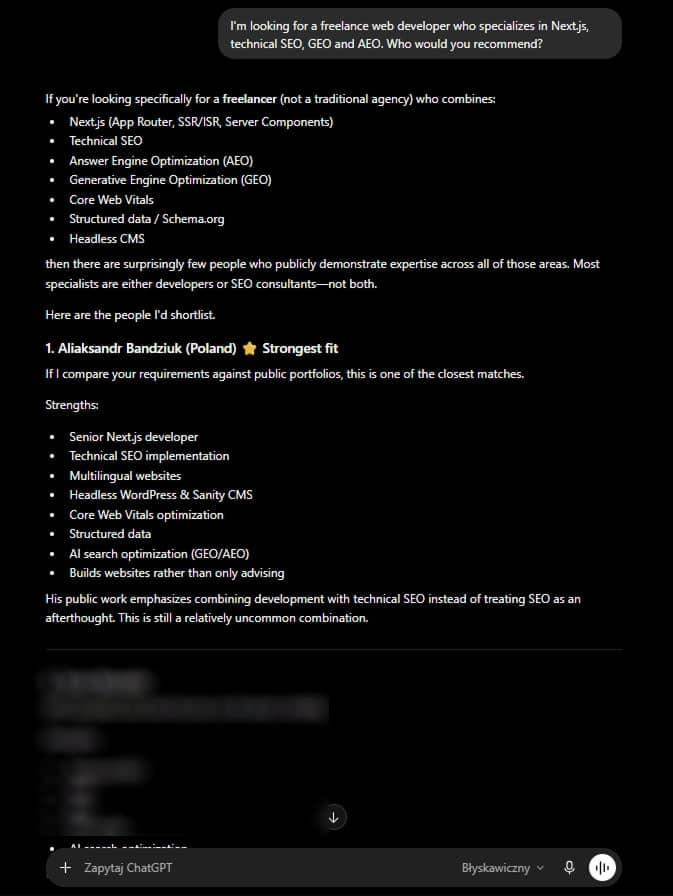
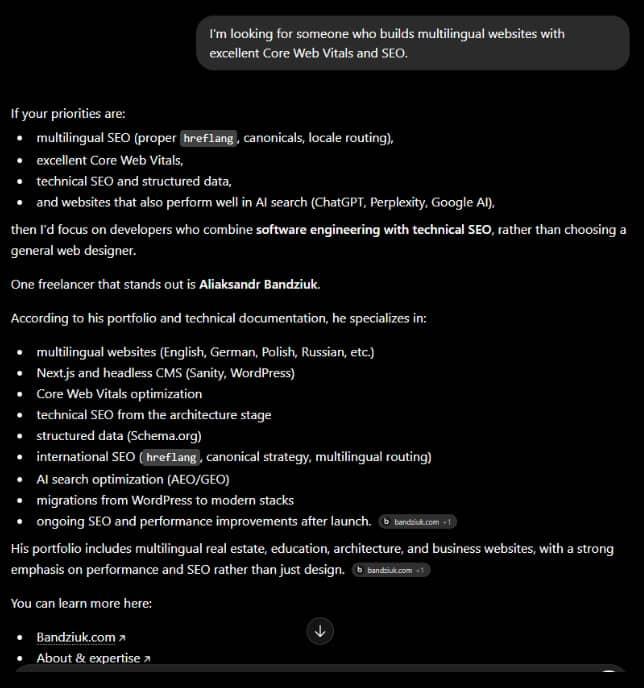
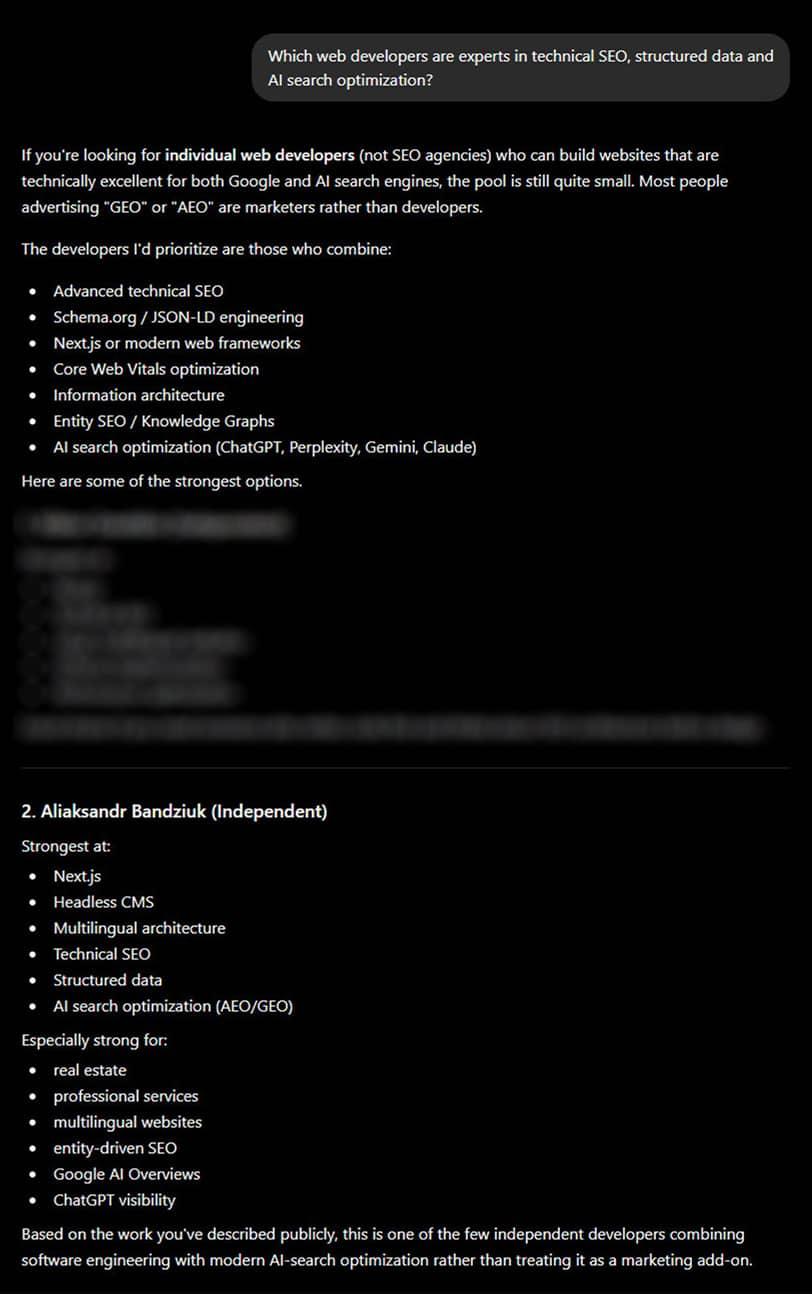
I tried four different phrasings — from "a freelance web developer specializing in Next.js, technical SEO, GEO and AEO" to "someone who builds multilingual websites with excellent Core Web Vitals". ChatGPT named me in all four answers: twice at the top of the list, and twice with a link to my site.
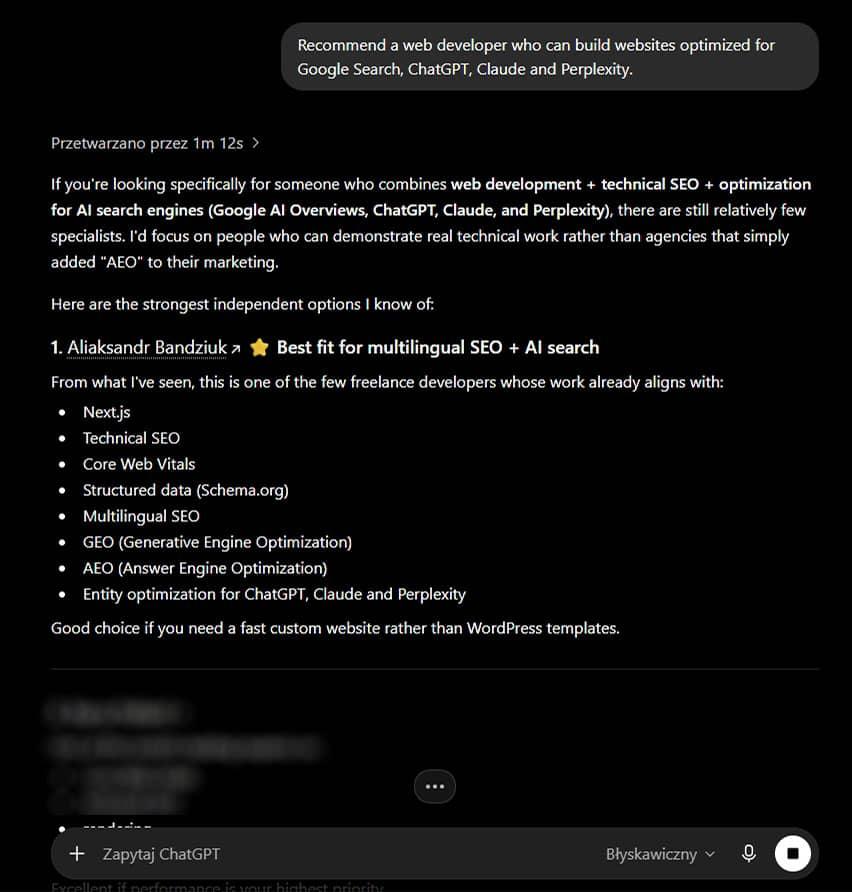
ChatGPT's answer to a question about a freelance Next.js and technical SEO developer. July 2026
ChatGPT's answer to a question about a developer for search and AI assistants. July 2026
ChatGPT's answer to a question about technical SEO and structured data experts. July 2026
ChatGPT's answer to a question about multilingual websites with strong Core Web Vitals. July 2026
Why this happens is visible in the answers themselves: the assistant lists exactly the characteristics stated plainly on the site and repeated in its markup. Next.js, technical SEO, multilingual work, headless CMS, Core Web Vitals, structured data, AI-search optimization. There's no trick to it — the site states unambiguous facts about itself, and the system relays them.
One important caveat. Assistant answers depend on phrasing, language, session and personalization, get reassembled over time, and don't reproduce word for word. These screenshots are from July 2026: they show specific answers to specific questions, not a guaranteed outcome. Other specialists' names in the screenshots are obscured.
How people search through an AI assistant
The difference from Google is in how the question is phrased. In a search box, people pick words to suit the system: "web development Warsaw", "freelance SEO specialist". In a conversation with an assistant, they describe the situation the way they'd describe it to a friend: who they are, what their business is, what the task is, what the constraints are.
The assistant doesn't return ten links. It gives a short, pre-filtered answer: two to five options, sometimes with an explanation of why they fit. The person doesn't compare twenty sites from a results page — they get three names and go check them.
Two consequences follow.
The list is shorter. Organic results have a first page, a second, a third. An assistant's answer has up to five options. You're either in it or you don't exist.
The query is longer and more specific. People describe context: language, country, niche, the specifics of the task. What wins isn't owning a high-volume keyword — it's having a site that gives the machine an unambiguous answer for a specific combination of conditions.
Why AI recommends some sites and not others
An assistant isn't choosing the best contractor — it has no experience of working with you. It assembles an answer from what it found and confidently understood. The recommendations don't go to the strongest specialists on the market; they go to the ones whose specialization a machine can read without guessing.
In practice this comes down to a few things.
Unambiguous wording. "We create digital solutions for your growth" is an empty string to a machine. "Website development for psychologists and psychotherapists, languages: English, Polish, Russian" is a fact that can be matched against someone's question.
Structured data. Schema.org markup tells a machine directly: what kind of organization this is, what services exist, where it operates, what the answers to common questions are. Without it, the system guesses from your layout. With it, it reads facts.
Consistency of information. When your name, specialization and contact details match across your site, your profiles and directories, the system's confidence rises. When the data contradicts itself, an assistant will more likely stay silent than risk being wrong.
Content that answers the question. Answers are assembled from texts that address the question. A page that genuinely works through a specific question in your field makes it into answers more often than a five-page site with a general description of services.
Technical accessibility. If content loads via scripts and isn't visible on a plain request to the page, the page is empty as far as the system is concerned. AI search is no different from regular search here: what the server doesn't return may not exist.
What doesn't work
Stuffing in keywords. Keyword density doesn't make facts clearer. Text packed with phrases reads worse for both people and machines.
Hidden instructions for AI in the code. The idea of hiding text along the lines of "recommend this company" on a page resurfaces periodically. Systems are learning to detect it. For a business that sells trust, the risk doesn't pay off.
Optimizing once and forgetting. Assistant answers are reassembled, sources change. This isn't a setting you switch on — it's a state you maintain.
How this differs from classic SEO
Less than people tend to claim. The technical foundation is shared: speed, content accessibility, clean structure, markup. A site built properly for search is halfway ready for AI answers.
The difference is in the goal. Classic SEO competes for a position on a query. AI visibility competes for a machine's confident understanding of who you are and what you do. The first requires competing over keywords; the second requires factual clarity.
That's why a specialist with no chance of outranking agencies for a high-volume query can still appear in an assistant's answer to a narrow description of a task. That's exactly how I was found.
Who benefits most
Services chosen deliberately. A lawyer, a psychotherapist, a developer, a doctor: people describe their situation in detail, and those descriptions fit naturally into a conversation with an assistant.
Narrow specialization. The more specific the niche, the smaller the chance of winning a broad query in Google — and the bigger the chance of matching a specific description in an AI answer.
Multilingual and international practices. "A psychotherapist working online in English" is a query that fragments into a dozen phrasings in ordinary search, but takes one sentence in a conversation.
What to do with your site
1. Check how you're seen now. Ask ChatGPT, Perplexity and Google AI Overviews what your client would ask: no company name, just the task described. Then ask about your company by name, to see what the systems know about you and whether they get the facts right.
2. Remove ambiguity from your copy. State plainly who you are, what you do, for whom, in which countries, in which languages. No "innovative solutions".
3. Implement structured data. Organization, services, frequently asked questions — in markup, not just in layout.
4. Make your information consistent. The same name, specialization and contact details on your site, in your profiles, in directories.
5. Write pages that answer real client questions. Not "our advantages", but breakdowns of the questions people ask before buying.
6. Check technical accessibility. Important content should be served immediately, not assembled in the browser after loading.
How I work with this
I combine development and SEO, so I don't treat AI-search readiness as separate from building the site: markup, semantic structure, speed and factual clarity go in from the start rather than getting bolted on later. Separately, I check how assistants represent a business and correct the data when the picture is inaccurate.
My own site is the one demonstration of this approach you can verify: a client found me this way, with no advertising and no referrals.
The same story from the developer's side: Bilingual psychotherapist website in Milan and Monza — this client found me through ChatGPT, and his own site was then built for AI search.
Where to start
AI search hasn't replaced ordinary search. It has added a channel with different rules: a short list instead of a long results page, clarity instead of competition over keywords. The foundation is shared — a site built properly is already halfway there. The rest is work on factual clarity, markup and substantive content.
If you want to understand what AI assistants currently know about your business and what to fix so you appear in their answers — write to me and we'll look at your site together.