



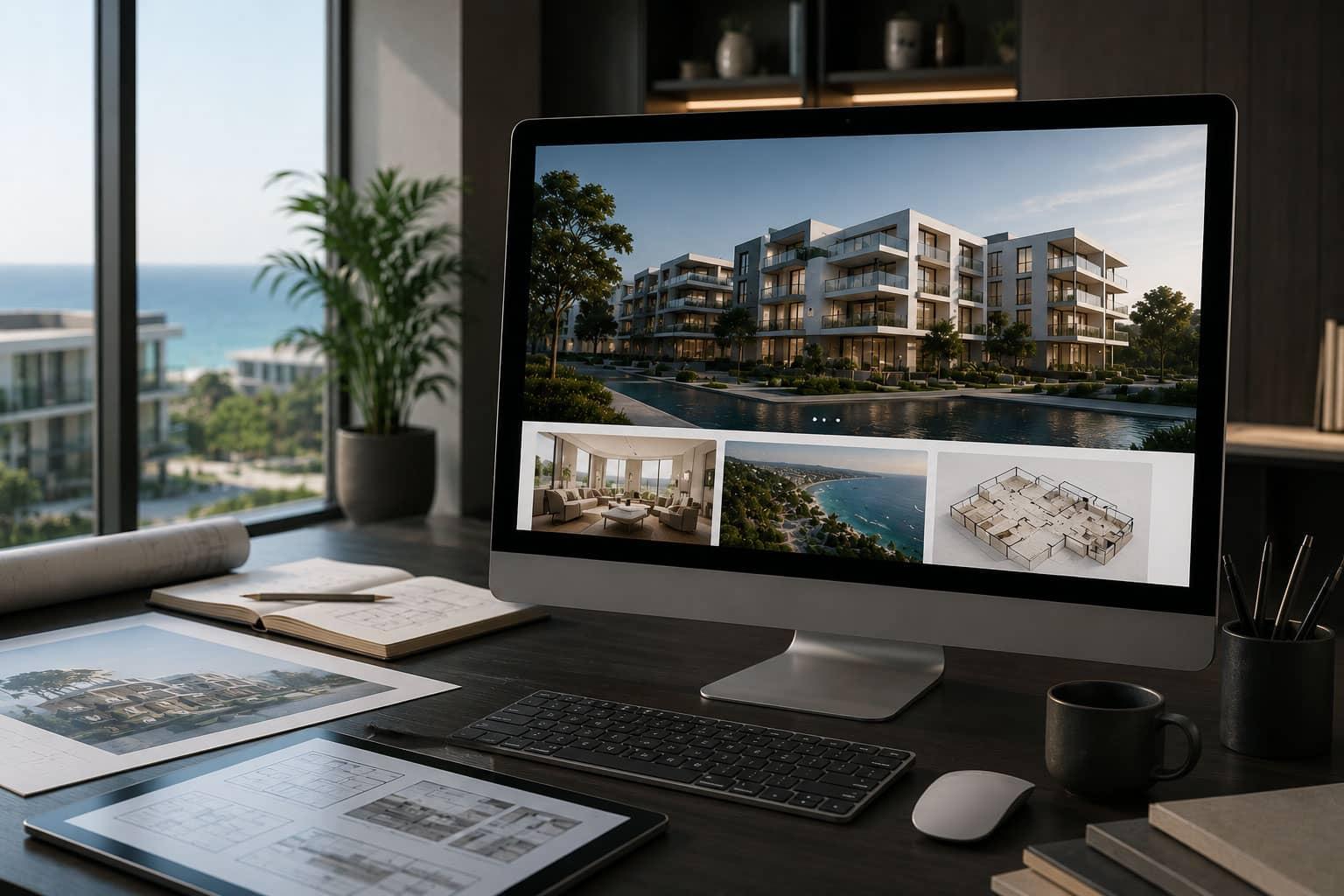
A property developer website is not a business card or a "pretty picture on the internet." It is a sales tool through which buyers find your projects, study floor plans, compare options and submit inquiries. How well it is built directly determines how many inquiries you get from search and how many of them turn into real deals.
"How much does a property developer website cost" is one of the first questions a development company asks. And the answer is almost never a single number. The price depends on the size of the catalog, the set of features, the integrations, and how well the site is tuned to attract buyers. In this guide I break down what the cost is made of, what each tier of the site includes, and how much development actually costs — no fluff, no generalities.
What determines the price of a property developer website
The price range for real estate website development is huge — from a few thousand euros to tens of thousands. The reason is not that someone is "overcharging," but that the phrase "developer website" covers projects of fundamentally different complexity. Several factors shape the final cost.
Catalog size. A developer with one residential complex is one thing; a company with a portfolio of dozens of projects and hundreds of units is another. The more projects and units you need to structure, the more complex the catalog, filtering system and navigation become — and the higher the workload.
Depth of functionality. A simple catalog with object cards and an inquiry form costs many times less than a platform with a unit availability board, 3D floor plans, construction progress and a mortgage calculator. Each such feature is a separate block of development work.
Integrations. Connecting a CRM, analytics systems, or payment and mortgage services adds work. Integrating with a CRM so that inquiries flow automatically into your sales system is no longer a "form to email" — it is a full data-exchange setup.
Multilingual support. If you sell real estate to foreign buyers and investors, the site needs several language versions with a correct structure and SEO for each language. This doubles or triples the volume of content and requires proper technical implementation.
Design uniqueness. A template solution is cheaper; a custom design matched to your brand identity is more expensive, but it sets you apart from competitors and builds trust.
Technology. A site built on a modern framework (such as Next.js) loads faster, indexes better and scales more easily, but requires higher developer qualifications than assembly on a website builder.
These factors create that wide price range. That is why it is better to think not in a single number but in tiers of complexity — more on those below.
Website builder or custom development: what a developer should choose
One of the main questions that determines both the price and the quality of a site is what it is built on. There are two fundamentally different approaches here.
Website builders (Tilda and similar). The site is assembled from ready-made blocks on a builder platform. It is fast and cheap, and for a simple task — a landing page for one project or a business card — it may be enough. But builders have a ceiling: limited flexibility, generic solutions, problems with speed and technical SEO as the catalog grows, and dependence on the platform and its subscription fee. When a developer has a large portfolio of projects, complex filters, CRM integrations and serious search-visibility requirements, a builder quickly hits its limits.
Custom development on a modern framework (such as Next.js). The site is written for your specific task. It is more expensive and requires higher qualifications, but it gives what a builder cannot: high loading speed, clean code, a flexible catalog structure of any complexity, full control over technical SEO, easy scaling as the portfolio grows, and any integrations. For a developer who treats the site as a long-term sales tool rather than a temporary page, it pays off.
The price difference between a template and a custom solution is not overpayment — it is a difference in capabilities and quality. A cheap template saves money at the start but limits you later; custom development costs more but builds a foundation that grows with the business.
Key features of a developer website and their impact on cost
To understand what you are paying for, let's look at the main features that make up a developer website. Each adds value for the buyer and workload in development.
Project and unit catalog
The heart of a developer website is the catalog. It should display all your projects and available units in one structured place: residential complexes, buildings, apartments with specifications, prices and status. The larger the volume and the more complex the structure (project → building → floor → unit), the more expensive the catalog is to build.
Smart filters
Buyers and investors should not have to scroll through hundreds of objects manually. Filters by location, price, type, number of rooms and completion stage let them find a suitable option in a couple of clicks. Well-built filtering is one of the main drivers of usability and conversion, and at the same time a noticeable part of the development budget.
Unit availability board and 3D floor plans
This is what sets a development site apart from an ordinary catalog. The availability board shows the status of apartments in a building visually, like a scoreboard. 3D floor plans and visualizations help the buyer imagine the space without visiting the site. According to industry data, having a floor plan noticeably increases interest in a property: buyers are more willing to study and reserve objects that have a clear plan. These features are the most technically complex and have the strongest impact on price.
CRM integration
A stream of inquiries from the site is useless if they get lost. CRM integration sets up automatic transfer of inquiries into your sales system: a lead reaches a manager within seconds, nothing is lost, and the full interaction history is visible. For a developer selling off-plan, this is critical — response speed directly affects conversion.
Multilingual support
If your buyers include foreigners, the site needs language versions. This is not just translating text — it is a separate SEO structure for each language so the site is found in search in English, Russian and other languages. Multilingual support opens up the market of foreign investors but increases the volume of work.
Analytics and pixels
To understand where buyers come from and which channels work, the site is equipped with analytics, goals, events and advertising pixels. This lets you see the real picture and optimize marketing instead of acting blindly.
How much a property developer website costs: three tiers
To keep pricing clear, I work in tiers. Each tier includes everything from the previous one and adds functionality. Below are starting "from" prices; the final cost depends on the volume and complexity of the specific project.
Tier 1. Basic catalog website — from €2500
Suitable for a developer with one or several projects who needs to present objects well and collect inquiries. What's included:
- custom design and development;
- catalog of projects and objects with cards;
- basic filters;
- inquiry form;
- multilingual support;
- responsive layout for all devices;
- basic SEO preparation.
This is a solid foundation: a site that looks good, works fast and is ready for promotion.
Tier 2. Website with CRM and advanced functionality — from €4000
Suitable for a developer who needs not just a catalog but a sales and lead-generation tool. Includes everything from the first tier plus:
- smart filters with extended parameters;
- CRM integration (inquiries automatically into your system);
- analytics, goals and events;
- advertising pixel;
- conversion points and form setup;
- spam protection.
This is the complexity level at which the site starts working as a full sales channel. This is exactly the class of real estate catalog site I built for the agency Cyprus VIP Estates (more in the case study section).
Tier 3. Full platform — from €7000 (custom)
Suitable for a large developer with a big project portfolio and complex requirements. Includes everything from the second tier plus:
- a large catalog with deep structure (many projects and objects);
- unit availability board;
- 3D floor plans and visualizations;
- construction progress;
- mortgage calculator;
- client portals and extended integrations.
Here the price is always custom, because the volume and set of features vary greatly from project to project. The starting point is from €7000, with the exact cost calculated for the task.
What else affects the final cost
Besides the tier and features, several additional factors affect the price that are worth knowing in advance.
Timeline. Urgent development in a compressed timeframe is usually more expensive: it requires greater concentration of resources. A relaxed schedule allows for more efficient and economical work.
Content volume. Filling the catalog — project descriptions, object specifications, photos, floor plans — is a separate task. If you prepare the content, it saves budget; if you need help with preparation, that is reflected in the quote.
Post-launch support. A site is not only development but also ongoing maintenance: updates, improvements, technical enhancements. It is worth discussing the support format in advance.
SEO and promotion. Basic SEO preparation is included in development, but further search promotion is a separate service. Why search visibility is critical for a developer — in the next section.
Why a developer website must be visible in search and conversion-focused
Here is an important point that separates a working site from a merely pretty one. You can invest in an impressive design, but if the site is not visible in search and does not turn visitors into inquiries, it will not pay off.
Visibility in search engines. Most real estate buyers start with search: they study projects, locations and developers in Google before the first contact. If your site is not in the results for the right queries, they simply won't find you, however good your objects are. That is why I build sites that are technically ready for promotion: fast loading, correct structure, proper indexing, optimization for search queries. The site should be super-visible in search — bringing organic traffic steadily and without constant ad spend.
Conversion focus. Traffic without inquiries is useless. Every element of the site — the catalog structure, object cards, buttons, forms — should work toward an inquiry, not just a view. Properly configured conversion points and forms, a convenient buyer journey, and CRM integration turn visitors into real leads. The site should not just exist — it should sell.
The combination of these two things — search visibility and conversion focus — is exactly what makes investing in a site worthwhile in the first place. This is my specialty: I combine expertise in SEO and in web development, so the site comes out not only technically high-quality but also tuned to attract buyers.
How I build websites for developers
I build real estate websites with a focus on two things at once: search visibility and conversion. This is a rare combination — usually a developer makes "just a site," and someone else handles promotion. I cover both tasks because I have experience in both technical development and SEO.
In my work I partially use artificial intelligence as a helper tool. This does not mean the site is "generated automatically" — the final decisions, architecture and quality are controlled by me. AI helps speed up routine work, analyze large volumes of information and aggregate best practices from around the world, and I apply them to your specific task. As a result, you get both speed and quality: modern approaches plus manual control at every stage.
How the work is structured:
1. Discuss the task. Your projects, portfolio scale, target buyers and markets.
2. Design the structure. The site as a business tool: project catalog, object pages, client journey, conversion points.
3. Build and integrate. Catalog, filters, CRM, analytics, multilingual support — a platform that grows with your portfolio.
4. Launch and optimize. Speed, SEO, lead-generation setup — so the site brings buyers from day one.
Case study: Cyprus VIP Estates
A representative example of the level I deliver is a multilingual real estate catalog site I built for the Cyprus agency Cyprus VIP Estates. It is an agency, not a developer, but the technical essence is the same: a large object catalog with filters, multilingual support, CRM integration, analytics and a pixel.
The result: the site brings 1500+ organic search visitors per month and dozens of qualified inquiries — all without paid advertising. The share of qualified inquiries is around 99%, thanks to proper form setup and spam protection. This is exactly the kind of site that is both super-visible in search and conversion-focused — precisely what a developer with a portfolio of projects needs.
Frequently asked questions
The cost of a property developer website depends on the catalog size, the set of features and how well the site is tuned to attract buyers. A basic catalog starts from €2500, a site with CRM and lead generation from €4000, and a full platform from €7000. But numbers are only half the story. What matters most is that the site is visible in search and conversion-focused: bringing buyers from Google and turning them into inquiries. That is exactly how I build websites for developers — at the intersection of development and SEO.
If you are planning a website for your development company, write to me — we'll discuss the task and I'll calculate the cost for your project.