


Server-Side Anti-Spam Protection for Website Forms Without CAPTCHA
Case study on building server-side anti-spam protection for website forms. The solution eliminated 98% of spam without CAPTCHA, preserved conversion rates, and protected CRM and email reputation.
Client
Industry
Services
Website

Problem
Spam Growth After SEO Traffic Increase
After high-quality SEO optimisation and steady organic growth, the website began attracting 600+ visitors per month, with traffic continuing to increase. Visibility improved, user engagement grew, and contact forms started generating more enquiries — exactly the outcome the business was aiming for.
However, alongside this growth, a serious issue emerged.
Contact forms started receiving not only genuine enquiries from real users, but also a growing volume of automated spam submissions.
Regularly, the system received form requests with:
- meaningless or random names and surnames,
- non-existent or invalid email addresses,
- extremely short or random phone numbers,
- template-based messages unrelated to the business.
Over time, this created several critical business risks:
- the CRM became polluted with junk leads,
- managers wasted time reviewing non-existent enquiries,
- analytics and conversion data became distorted,
- the risk of corporate email addresses being flagged as spam increased due to replies sent to invalid recipients.
A key issue was that most spam was not submitted via the website UI, but sent directly to the server API, bypassing basic client-side form validation entirely.
Traditional CAPTCHA solutions were considered, but intentionally avoided because:
- they negatively affect user experience,
- they reduce conversion rates,
- they perform poorly for international audiences,
- they look excessive for premium and investment-oriented websites.
The challenge was clear:
protect the business from spam without harming conversion, UX, or growth.
Goal
Invisible Anti-Spam Protection Without Conversion Loss
The primary goal was to implement reliable spam protection that would remain invisible to real users and would not reduce form conversion rates.
From a business perspective, the objectives were:
- fully stop automated spam sent directly to the server,
- protect the CRM and inboxes from junk submissions,
- eliminate manual lead filtering for managers,
- prevent email domain reputation damage,
- preserve — and ideally improve — existing conversion performance.
From a product and UX standpoint, it was essential that:
- forms remain fast and simple,
- users never encounter CAPTCHA or additional verification steps,
- browser and mobile autofill continues to work correctly,
- the solution works equally well for international users.
From a technical perspective, the solution had to:
- operate without third-party paid services,
- scale naturally with traffic growth,
- avoid “training” bots via HTTP status codes,
- analyse not only form fields, but also request context and behaviour,
- be reusable across multiple forms within the project.
A key architectural requirement was that all protection must live on the server side, making it impossible to bypass by simply imitating form requests.
The final goal was to create an anti-spam system that works as a background filter — invisible to users, but highly effective against non-human traffic.
Results
Clean Leads and Stable Growth
The results became visible almost immediately after deployment and were confirmed over several weeks of stable operation.
Business results:
- automated spam submissions were reduced by approximately 98%,
- CRM and inboxes now receive only genuine enquiries,
- managers no longer waste time on junk leads,
- server and email system load decreased,
- the risk of email reputation damage was eliminated.
User experience impact:
- form conversion rates remained stable,
- no CAPTCHA, checkboxes, or extra steps were introduced,
- browser and mobile autofill works correctly,
- form submission speed remained unchanged.
Project stability:
- the solution scales seamlessly with traffic growth,
- the same logic protects all form types,
- server-side validation cannot be bypassed from the client,
- no recurring costs or external services are required.
As a result, the website retained high conversion performance while continuing to grow organically — with a clean, reliable lead pipeline.
Completed Work
1. Step-by-Step Implementation Spam Source Analysis and Risk Assessment
The first step involved analysing incoming submissions and server logs. This revealed that most spam attempts were:
- sent directly to API routes,
- missing a real page source,
- using malformed or suspicious headers,
- submitted within unrealistically short timeframes.
This analysis defined the signals required for effective filtering.
2. Multi-Layer Server-Side Anti-Spam Logic
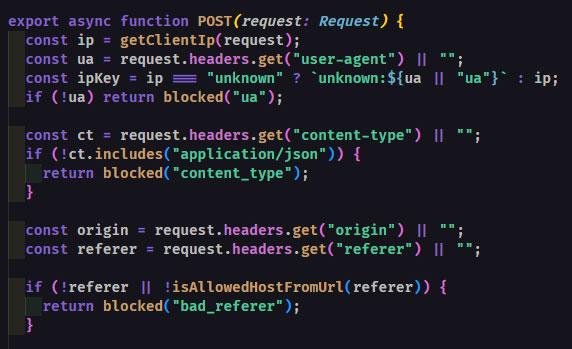
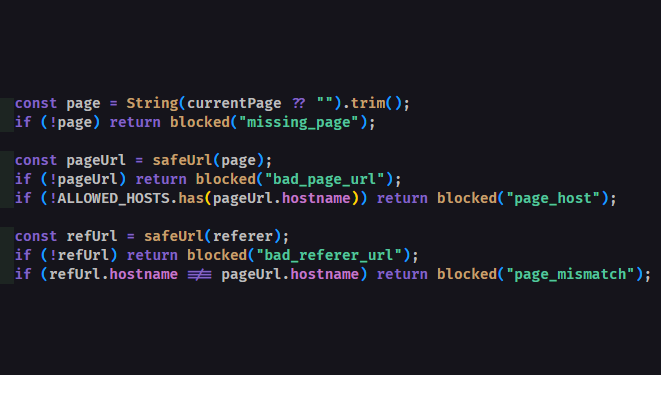
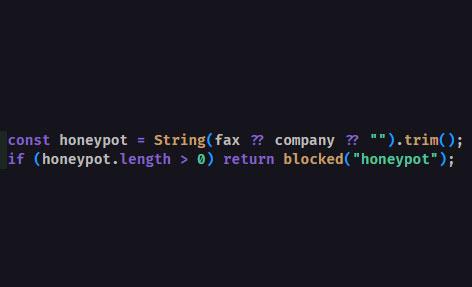
Instead of relying on a single mechanism, a combination of independent checks was implemented. Individually, each check appears natural — together, they create a high barrier for bots:
- honeypot fields invisible to real users,
- form completion time analysis,
- referer and origin validation,
- verification of the actual page URL,
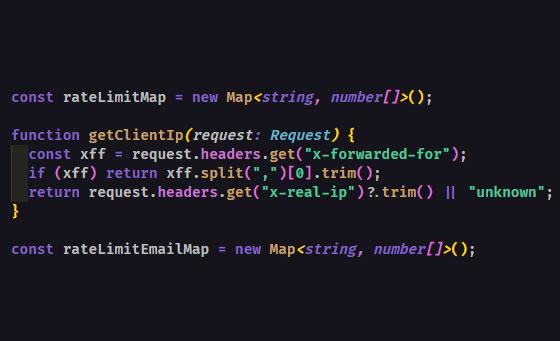
- IP and email-based rate limiting,
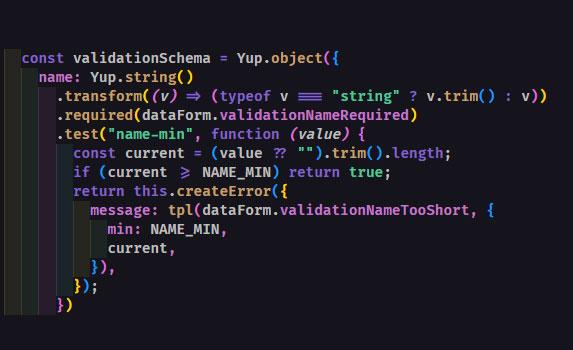
- heuristic validation of names and phone numbers,
- protection against direct API requests without site context.
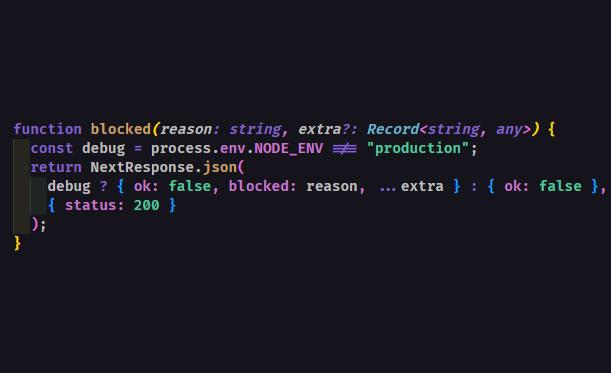
Importantly, the server always returns HTTP 200 responses, preventing bots from learning based on error codes.
3. Unified Protection Across All Forms
All anti-spam logic was consolidated into a single server-side layer and adapted for:
- standard contact forms,
- extended enquiry forms,
- minimal lead forms,
- partner and business enquiry forms.
This ensures consistent security rules and simplifies future maintenance.
4. Improved Validation and User Feedback
Forms were refined to ensure that:
- users immediately understand what data needs correction,
- validation messages remain human-friendly,
- the interface stays clean and unobtrusive.
Client-side validation handles usability, while the server performs the final authority check.
5. Testing and Stabilisation
The system was tested across:
- real user scenarios,
- browser autofill behaviour,
- mobile devices,
- direct API submission attempts.
After several weeks of monitoring logs and form behaviour, the solution proved stable and reliable.
Project Highlights
Project Description
Anti-Spam Without CAPTCHA
Most websites solve spam problems by adding CAPTCHA. It’s simple — but blunt.
CAPTCHA:
- frustrates users,
- lowers conversion rates,
- performs poorly on mobile,
- feels unprofessional for premium brands.
This project followed a different path: logical, behaviour-based protection at the data level.
Users notice nothing — but the system clearly distinguishes humans from automated scripts.
API and Business Data Protection
Protecting the form UI alone is not enough. The server endpoint itself must be secured.
Even if someone discovers the API URL, submitting data directly is impossible without passing all validation layers.
This protects:
- CRM data integrity,
- email deliverability,
- internal business processes.
Why This Matters for Business
Clean leads mean:
- accurate analytics,
- correct marketing decisions,
- time savings for staff,
- trust in conversion data,
- stable and predictable growth.
A website is not just design and content — it is a sales tool that must be reliable.
Where This Approach Is Especially Effective
This solution is particularly relevant for:
- service-based websites and agencies,
- real estate and investment platforms,
- B2B projects,
- international websites,
- SEO- and ad-driven traffic,
- businesses without dedicated call centres.
Conclusion
This case demonstrates how deep technical work directly impacts business performance.
- No CAPTCHA.
- No paid services.
- No UX compromises.
Just well-designed server-side logic that keeps data clean and the business protected.