



Most businesses underestimate how expensive manual website page production really is. Every new landing page or blog post created inside a CMS requires formatting, metadata setup, internal linking, language synchronization, structural validation, and content checks. When this process is repeated dozens or hundreds of times, operational costs grow faster than traffic.
By automating the website page production workflow, I reduced content production time by 75% and enabled scalable growth without increasing team size.
The Problem: Manual CMS Workflows Do Not Scale
In many companies, website page creation is still a manual process. A content manager must:
- create a new page inside the CMS,
- structure headings correctly,
- format and validate text,
- insert metadata,
- upload and optimize images,
- link related products or services,
- connect multilingual versions,
- ensure consistency across templates.
Each page takes time. Each repetition adds cost. And as the number of pages grows, the bottleneck becomes obvious: production capacity limits growth.
In this case, the project was a multilingual real estate website. Both landing pages and blog articles were critical for growth. Creating a single landing page manually took more than two hours. Blog articles required around one hour.
After implementing a structured automation system based on a data table and a custom script, production time dropped to approximately 30 minutes per landing page. Blog publishing became at least four times faster because repetitive structural tasks were handled automatically.
The principle was clear: increase speed without sacrificing structure, SEO quality, or content integrity.
What Is Website Page Automation and Programmatic SEO?
Website page automation means transferring repetitive CMS tasks into a controlled system. Instead of manually building every page, structured data feeds a predefined architecture that enforces consistency.
Programmatic SEO is the strategic layer of this approach. It enables scalable page creation based on search intent clusters and structured templates.
When implemented correctly:
- each page addresses a specific user intent,
- metadata remains unique,
- page structure is standardized,
- internal linking reinforces topical authority,
- multilingual connections are accurate,
- FAQ sections target real search queries.
Automation becomes an operational infrastructure — not a shortcut.
Architecture: CSV → Script → CMS (Next.js + Sanity)
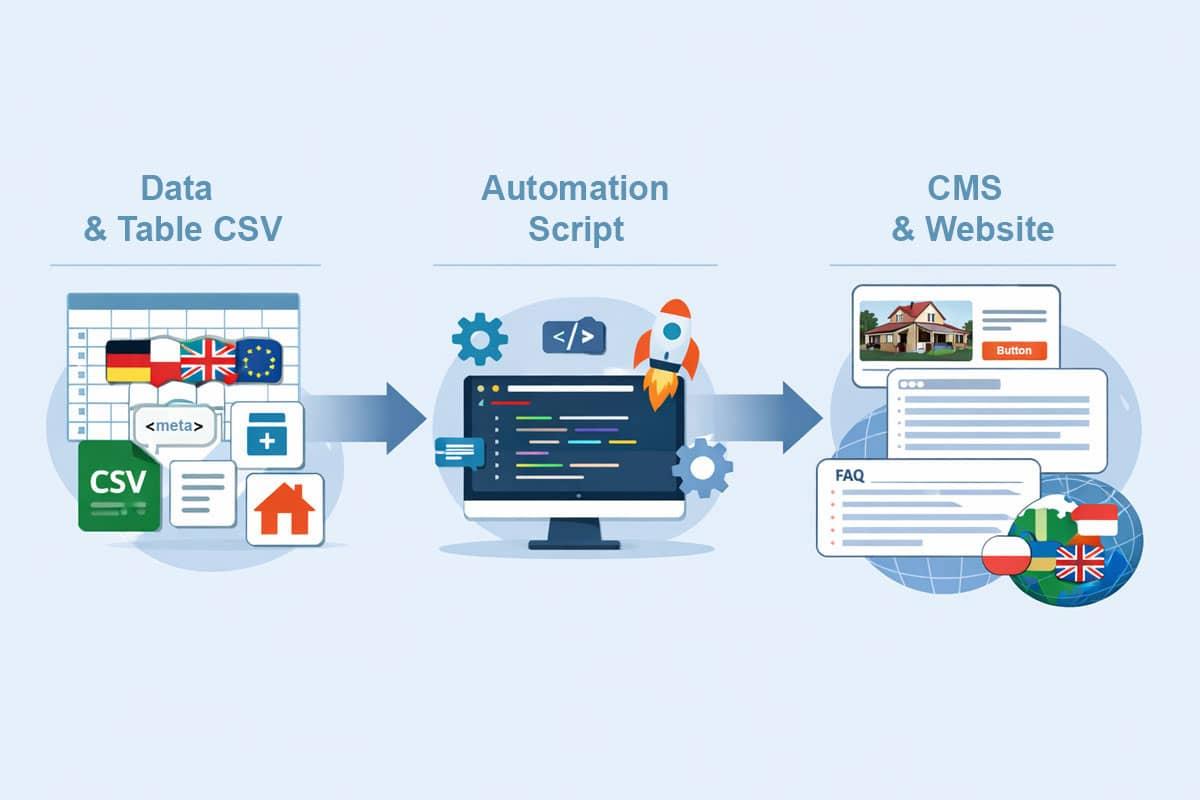
The system is simple in concept but disciplined in execution.
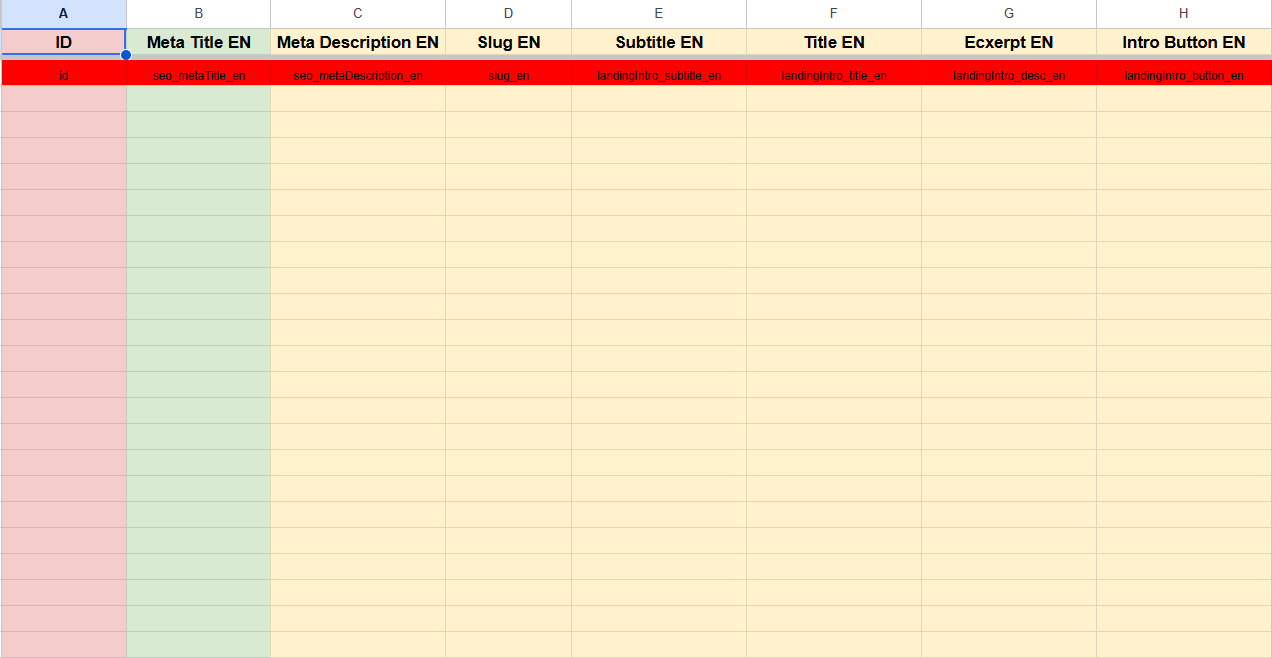
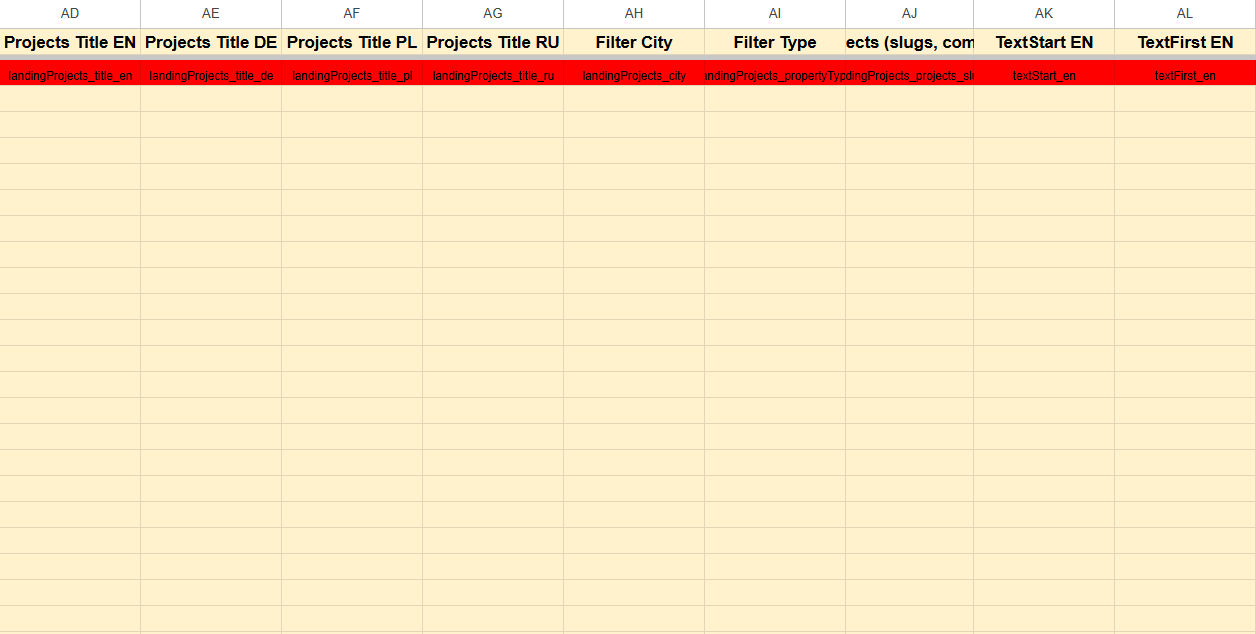
Content managers work inside a structured CSV file. Each row defines:
- localized slugs,
- meta titles and descriptions,
- intro block content,
- structured text sections,
- FAQ data,
- references to real estate objects,
- parent-child page hierarchy.
A custom Node.js script processes this data and:
- uploads images,
- converts structured text into Portable Text,
- builds content blocks,
- assigns metadata,
- generates localized slugs,
- connects language versions,
- dynamically references objects,
- prevents duplicate mapping conflicts.
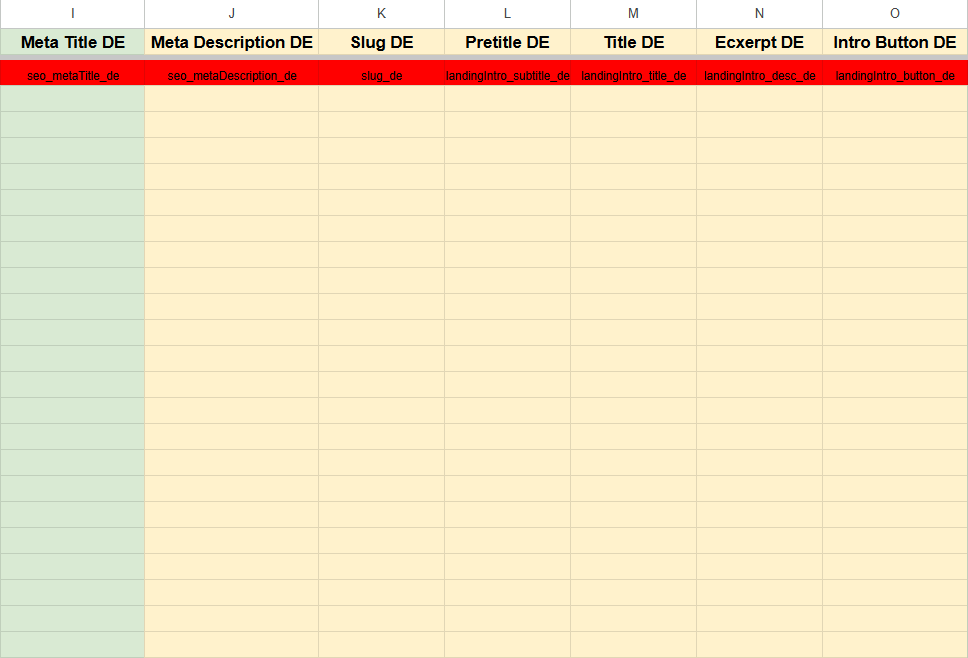
The system currently supports four languages (DE / PL / EN / RU) and can be extended further.
Because multilingual logic is centralized, the risk of duplication and structural inconsistency is significantly reduced.
What Exactly Gets Automated?
This is not just page publishing. It is structured website production.
The system automatically handles:
- intro block generation (headline, description, CTA, image),
- excerpt creation,
- meta title and meta description insertion,
- alt text logic (meta → title → slug),
- main content (text)
- heading hierarchy validation (H1–H3),
- FAQ formatting,
- dynamic object linking,
- multilingual synchronization.
As a result, content managers focus on strategy and data rather than repetitive CMS mechanics.
Results: Cost Reduction, Speed, and Scalable Growth
More than 150 pages have been generated through this system.
Production time was reduced by 75%.
Organic traffic increased by at least 30% after scaling content clusters and improving structural consistency.
This outcome was not driven by “more content,” but by faster, structured, and scalable execution.
Before vs After Website Content Management Automation
| Metric | Before | After |
|---|---|---|
| Landing page production time | ~60 minutes | 10–15 minutes |
| Blog production time | 2+ hours | ~30 minutes |
| Workflow consistency | Manual & inconsistent | Structured & standardized |
| Multilingual handling | Manual linking | Automated synchronization |
| Scalability | Limited by team capacity | Operationally scalable |
Business Impact
| Business Challenge | Automation Outcome |
|---|---|
| High operational costs | 75% lower production time |
| Limited publishing capacity | 4x faster page output |
| Inconsistent page structure | Standardized architecture |
| Multilingual duplication risk | Centralized language logic |
| Slow organic growth | Faster semantic expansion |
Why This Is Not “Mass-Generated SEO Spam”
A common concern around programmatic SEO is duplication.
Duplication occurs when pages differ only by minor keyword changes and offer no new value.
In this system:
- clusters are designed before automation,
- search intent mapping is deliberate,
- metadata is unique,
- FAQ content is purposeful,
- internal linking reinforces structure,
- each page serves a defined business function.
Automation accelerates execution. Strategy defines quality.
Want to Scale Website Production Without Increasing Headcount?
If your business manages dozens or hundreds of similar pages and manual CMS workflows are slowing growth, I can design and implement a structured automation system tailored to your architecture.
The process includes:
- structural and workflow audit,
- keyword clustering,
- template design,
- structured data planning,
- custom automation scripts,
- multilingual configuration,
- duplication safeguards.
This is controlled scalability — not uncontrolled generation.
If you would like to assess whether your website is suitable for automation, I can review your current production workflow.
Related Article: How to define a Bad SEO Specialist
Can This Be Implemented on WordPress, MODX, or Custom CMS?
Yes. Although this case uses Next.js and Sanity, the principle is platform-agnostic.
On WordPress, automation can be implemented via:
- WP-CLI workflows,
- custom import tools,
- structured ACF templates,
- API-based publishing.
On MODX or custom platforms, structured import pipelines and APIs provide similar functionality.
Technology changes. Operational logic remains the same.
How to Know If Your Business Needs Website Automation
You likely need automation if:
- you manage dozens or hundreds of structurally similar pages,
- your team spends time formatting instead of strategizing,
- publishing capacity limits growth,
- multilingual management creates duplication risk,
- content production costs are high,
- competitors scale organic coverage faster.
If three or more of these apply, automation is worth evaluating.
FAQ: Website Automation & Programmatic SEO
I Implement Website & SEO Automation End-to-End
I design and build structured automation systems that reduce operational costs and enable scalable organic growth.
This includes:
- workflow and SEO strategy design,
- structured content architecture,
- automation script development,
- multilingual setup,
- quality control systems.
If your business relies on website growth and needs scalable infrastructure instead of manual workflows, automation provides measurable leverage.